Pages

Friday, February 06, 2009

More Owl Pellet Data

The Young Scholars Program at Cambridge Elementary School (NY) has given me a chance to collect more data on owl prey preference. Here it is:

5 pellets dissected included the remains of:

11 mice, 1 shrew, 0 moles, 0 birds

That is an average of 2.4 animals eaten for each pellet produced.

Look at these other postings of owl pellet study for more data - Bushkill Elementary Owl Ecologists and Owl Pellets and Predator Prey Relationships

Here we are having a discussion on the three common owls of the Cambridge, NY area - the eastern screech-owl, the great-horned owl and the barred owl. The barn owl has been included in the discussion even though it is not usually found in NewYork state because the pellets that we dissect come from barn owls.


Students are busy dissecting owl pellets looking for the bones of the owl's prey. The owl eat the prey whole. Very quickly in the digestion process the bones, fur and feather (in the event that the owl has eaten a bird) are packed into a ball and regurgitated.


Here is some of the hands-on investigation that reveals what the owl ate to produce a pellet.


I have some specimens of prey items that I will photograph and post soon.

Wednesday, February 04, 2009

bushkill elementary owl ecologists

My apologies to the 4th grade Ornithologists at Bushkill Elementary School in Nazareth, PA. I had meant to get their data online sooner but got tied up in a conference on children’s summer camps and nature programs.

During the week of January 26th we investigated the predator preferences of barn owls by dissecting owl pellets. The owl pellets were purchased from Pellets Inc. and come from the Pacific Northwest. Here is the data we collected regarding the kinds of prey barn owls eat and how many they eat in a meal that produces a pellet.

DeBoer’s class - 10 pellets dissected produced 23 mice, 1 shrew, 1 mole, 1 bird
Roth’s class - 11 pellets dissected produced 24 mice, 0 shrews, 0 moles, 0 birds
Hahn’s class - 10 pellets dissected produced 23 mice, 1 shrew, 0 moles, 0 birds
Apruzzi’s and Stump’s classes (combined) - 22 pellets dissected produced 41 mice, 1 shrew, 2 moles, 0 birds

In each class we had discussed our hypothesis that mice were the most preferred food, followed distantly by shrews, with moles and birds tied for the least desired. With each class it was clear that barn owls definitely prey more on mice than any other animal. In each class though, it wasn’t as clear as to any difference in preference for shrews, moles or birds. The percentage of prey eaten listed by class follows:

DeBoer – 88% mice, 4% shrews, 4% moles, 4% birds
Roth – 100% mice, 0% shrews, 0% moles, 0% birds
Hahn – 96% mice, 4% shrews, 0% moles, 0% birds
Apruzzi and Stump – 93% mice, 2% shrews, 5% moles, 0% birds

We agreed that we did not have a large enough sample to have a clear picture of the predation on the three less favored kinds of prey. In order to collect more data we would need to dissect more pellets. Much as the students would have loved to done this neither time nor funding allowed it. By combining the information for all three groups though, a different picture emerges. Taken in whole the 4th grades dissected a total of 53 pellets and found the following: 94% mice, 2.5% shrews, 2.5% moles, 1% birds. Perhaps we still do not have a big enough picture and should take apart even more pellets. Since we can't take apart more pellets we can look at data collected by other schools that I have worked with - see Previous Posts: Owl Pellets and Predator Prey Relationships for Monday, January 19 and the data collected by Jefferson Elementary students. How does this alter our conclusions about barn owl food preference?

One final aspect of predator prey relationship is illustrated with our dissection, the balance of nature, the number of predators balance with the number of prey. Our dissection revealed that 118 animals were eaten to produce 53 pellets. That is an average of 2.2 animals per pellet. An owl will produce about 4 pellets a night. That means in one night a barn owl will eat about 9 animals (mostly mice). In one year that owl will eat about 3,300 mice (and other small animals). Mice are prolific breeders. Owls keep the mouse population in balance by preying on these many small creatures.

Saturday, January 24, 2009

Ornithology and Mid-winter Bird Survey at Bushkill Elementary

At the Bushkill Elementary School in Nazareth, PA, 5th grade students joined me as ornithologists doing a survey of winter birds in the school’s environmental area. Before going into the field we spent about 15 minutes inside talking about how birds are identified. Our discussion centered on how coloration, size, shape, behavior, habitat and calls or songs are used to identify birds with the use of bird field guides. The examples of field guides were A Field Guide to the Birds, Roger Tory Peterson, Field Guide to Birds of Eastern North America by David Allen Sibley, and Birds of Pennsylvania by Franklin Haas and Roger Burrows. The discussion included why ornithologist might do a bird survey. I mentioned that two bird surveys were currently in progress across the northeast, including a bald eagle survey and a waterfowl survey. Other surveys of birds are Christmas Bird Counts, Breeding Bird Atlas projects and feeder watch projects.

Some interesting observations included a Carolina Wren that flew from an evergreen into an old garage. I explained how this wren often uses garages and similar structures as shelter. We stood in front of the garage looking into the open door. I explained that sometimes to get a bird to appear ornithologist make a “spish” sound that imitates a bird warning call. This sound can entice a bird to pop up and look around to see what all the fuss is about, giving us a chance to see it. I proceeded to “spish” and the wren popped up from behind some barrels and flew up and out through an opening in the eaves.

We also had some very good looks at a couple of northern mockingbirds. One bird in particular was observed as it looked for food upon the ground. As we approached, it flew up into some wild rose bushes along a fence line, where it began to feed upon rose hips. This bird eventually flew off and joined another mockingbird in a clump of brush. We wondered if these two birds may be starting to look for a nesting site. Several crows were observed flying in pairs and searching upper branches of some of the oaks. Again we speculated that these birds were beginning to look for a place to eventually nest.

Another notable species was sharp-shinned hawk. Two were observed as they perched in trees at a great distance. The most exciting though, was an adult that flew right over the group providing most of the students a really good look at it. A fleeting glimpse of a brown creeper was seen flying in the wooded section. We searched for it in hopes of observing its distinctive feeding behavior on tree trunks. Creepers get their name because they creep up tree trunks. They never creep down. When a creeper reaches a high point it flies down to a lower point on the trunk and starts its climb up all over again. Unfortunately we did not see the creeper again.

Two species were identified by the song only. These included black-capped chickadee and house sparrow. It is likely that for both species there were several individuals present but because we did not see them we counted them as only one bird present.

The afternoon sessions seemed to produce the most numbers of birds, both days. The morning of the second day, with very little wind and sunny conditions proved to have the greatest number of birds with 9 species seen. A total of 15 bird species were seen in the two days.

The value in doing a survey like this is that it provides a glimpse of the kinds of birds that make use of the woodlot and open fields that are a part of the school’s environmental center. Over time this record might be useful in showing trend in the diversity of the kinds of birds and their numbers. These trends might then be related to changing environmental conditions. If negative trends were detected wildlife management plans might be developed to help the affected birds. This data would also be useful in land-use planning and decision making.

More information on birds, bird surveys and citizen science is available at the Cornell Laboratory of Ornithology. Click on the link to go to their website.

Our Survey Results
The birds are listed in taxonomic order.

Mrs. Dawe – 10:15 AM Thursday, Jan. 22, cloudy with strong westerly wind
Mourning Dove – 7
Blue Jay – 2
American Crow – 1
Starling – 1
Purple Finch – 1


Ms. Williams – 1:15 PM Thursday, Jan. 22, mostly sunny with no wind
Mourning Dove – 3
Downy Woodpecker – 1
American Crow – 14
Carolina Wren – 1
Starling – 12
Dark-eyed Junco – 3

Mr. Oberman – 10:15 AM Friday, Jan. 23, sunny with no wind
Sharp-shinned Hawk – 3
Blue Jay – 3
American Crow – 25
Black-capped Chickadee – 1
White-breasted Nuthatch – 1
Northern Mockingbird – 1
European Starling – 3
Dark-eyed Junco – 3
House Sparrow – 1

Mrs. Trach – 1:15 PM Friday, Jan. 23, sunny with no wind
Mourning Dove – 12
American Crow – 4
Brown Creeper - 1
American Robin – 20
Northern Mockingbird – 3
European Starling – 106

Monday, January 19, 2009

Owl Pellets and Predator Prey Relationships

Last Thursday, January 15, I visited the Jefferson Elementary School in the Schalmont CSD. I did Owl Ecology for the 5th graders. It's a fun session to do that gets students excited about science, helps illustrate scientific methods and gives the students a chance to explore and understand owls and their relationship to their prey.

There are many resources about owl pellet dissection. I suggest checking out pelletsinc. for owl pellets and teaching resources. You can click on the link to reach this great resource. Here I would like to give some thoughts on how dissecting owl pellets can lead into a discussion of predator prey relationship.

The culmination of the class is to analyze the results of the owl pellet dissection. From our investigation we know, not only what the owls ate, but also how many of each of their prey were eaten. On this day we had the following results:
Mrs. Guzewich's class - 11 pellets dissected - 19 mice, 6 shrews, 1 moles, 0 birds
Mrs. Fitzgerald's class - 10 pellets dissected - 22 mice, 4 shrews, 0 moles, 0 birds
Mrs. Walker's class - 10 pellets dissected - 23 mice, 0 shrews, 0 moles, 0 birds
Mrs. Wood's class - 11 pellets dissected - 25 mice, 8 shrews, 1 mole, 1 bird

The total number of pellets dissected was 42 with a total of 89 mice, 18 shrew, 2 moles and 1 bird. That gives an average of 2.6 prey per owl pellet for the samples investigated at Jefferson Elementary. A barn owl produces about 4 pellets a night. So in one night they might eat at least 10 animals. In one year an owl might eat over 3600 mice (mice being the most common prey - the numbers seen above can help illustrate a discussion of what the most common food for barn owls is). This large consumption of prey illustrates the concept of a balance in nature between predator and prey. Prey species reproduce in large numbers. These prey support a population of predators. As the predators increase the number of prey decreases. This smaller number of prey can not support as large a population of predators. The number of predators begin to decline. As the number of predators decreases the number of prey that survive can increase, eventually allowing for an increase in the number of predators. This balance of increasing, then decreasing then again increasing is part of the story behind population cycles of wildlife.

Wednesday, November 19, 2008

Pond Ecology at Central Valley and Circleville

In the last few weeks I’ve had the chance to do my ecologist-in-residence visits at the Central Valley Elementary School in the Monroe-Woodbury School District and the Circleville Elementary School in the Pine Bush School District where some of the students had a chance to be aquatic ecologists looking for animal life in the pond. This is one of my favorite sessions and one that the students and teachers all enjoy.

I bring in buckets of pond water (my favorite ponds to get samples from are at the Landis Arboretum in Esperance, NY – but you can find any of these creatures in most ponds throughout the Northeast). I explain how an aquatic ecologist tries to understand how pond organisms live, thrive and survive. I explain some of the equipment that an aquatic ecologist might use to investigate the pond environment. The students get to use my “uncamouflage” equipment (see my upcoming Aquatic Ecology Field Kit write-up coming soon) to capture and observe the many small creatures of the pond.

After a short time of capturing pond life we settled in for my final overview. I have taken some of the smallest samples and placed them in a special slides (available from Carolina Biological Supply Co., called “deep well slides”) that are used with old style slide projectors. I call these slides, "special aquariums" that can be used to magnify the pond animals, taking something that might be a quarter of an inch large and making it look about 30 or 40 times larger. We have the chance to look at the same enlarged creature and learn about "who is who, what they do, how they grow and where they go".

Here are a few of the creatures we recently found. All of these creatures are in the pond now as winter approaches. They will live under the ice through the winter and will be ready to continue on with their life cycle when the warm weather melts the ice on the pond next spring.


The scud or side swimmer is a kind of freshwater shrimp. They belong to a group of arthropods called amphipoda. They are scavenger, eating dead plant and animal material. They then are eaten by a lot of larger pond animals and thus are important parts of the food chain.
They often are easy to see but hard to catch. They are easy to see because they spend a lot of time swimming rapidly around in the water. They are hard to catch because as soon as they stop in a bunch of pond plants or detritus they disappear with they good camouflage.

One of my favorite creatures to show students is the phantom midge or gnat. It's called a phantom because it has a transparent (see-through) body. What a great adaptation for living in the water, to have a body that is see-through. Many times you don't notice that there is a midge larva in view. You see a few pieces of what looks like dirt floating in the water and then you see them wiggle around and notice the outline of a larva's body. Those little specks of dirt are the float bladders inside the midge that help it sink or float. You can also see it's digestive system.


The phantom midges or gnats are hunters. They use their antennae to catch small aquatic organisms and pull them to their mouths so that they can eat them. Here in this picture you can see these antennae. They look like a hook on top of the larva's head.


This past sample had hundreds of mayfly nymphs, most of them just about a quarter of an inch long. I suspect that most of these had hatched from eggs just before the cold weather arrived. They will live in the pond along with the other creatures we were capturing through the winter and be among the first of the pond insects to grow up and leave the pond next spring.


Mayfly nymphs are hunters in the pond. They will eat other small pond creatures like daphnia and copepods, along with aquatic worms and other insects.


When they are ready to leave the pond they will climb up out of the water on to a rock, or log, or dock, or something sticking out of the water and shed their exoskeleton one last time. This time their new exoskeleton will have something none of their past exoskeletons have had, wings!


When they leave the pond, though, they will have no digestive system. That means that the adult mayfly will not live long, but it leaves extra room for eggs in the females. They quickly find mates and lay eggs in the water for their species to continue on.


Here is a damselfly nymph. They are hunters while they live in the water. As they eat and grow they become to large for their exoskeletons and shed. Sometimes we are lucky and find the cast off exoskeleton they leave behind when they do.


When they are ready to leave the water they do the same as mayflies and climb up on to a dry area and shed their exoskeleton that also has new wings. They pump up their wings so that they are fully extended. The wings dry off and harden and off flies the damselfly to be a winged hunter chasing down and catching flying insects. One of their favorite insects to eat are mosquitoes.


I always leave the leach as the last of the critter to look at. What most people know about leaches if fiction from movies that they see, or folk tales that they've heard. Scientists are interested in the facts, not fiction. Here are some of the facts about leaches.

Most of the leeches that we find in a pond do not suck blood. They are either hunters or scavengers. All leeches have a suction cup tail that can grasp on to an animal like a duck or turtle. When the animal travels to another pond the leach takes a ride and can end up in a new pond far from where it started.

Blood sucking leeches get a bad rap. When they bite you usually don't feel it (not like deer flies or horse flies), after they bite it usually doesn't swell up or itch (not like mosquito or black fly bites) and to my knowledge there are no diseases passed on by leaches - not like a lot of other biting organisms like ticks [Lyme disease] or mosquitoes [West Nile virus or malaria]. They are important parts of the food chain, eating small animals or scavenging and then being food for larger animals like fish and if you eat the fish that you catch in a pond food in turn part of the food chain that ends in you.

Thursday, November 13, 2008

Decomposing Deer


Last year during my ecologist-in-residence at the Central Valley Elementary School we observed turkey vultures circling around what turned out to be a dead deer. During my visit this year with Mr. Petersen's class we went to check out what happened to the deer. We only found bones, mostly vertebrae and ribs along with one scapula, one femur and one humerus. Here's what I think happened to the dead deer as it decomposed and passed energy on to other organisms and returned nutrients to the environment.

The picture to the right shows a broken femur. I think the deer was hit by a car and ended up with a compound fracture of the femur. The impact of the car did not kill the deer right away and the deer was able to run up along the rock wall away from the highway. Through the action of running the sharp edges of the broken bone probably severed the femoral artery, resulting in the deer dieing.

The compound fracture would have left a gaping wound that the flies would have landed on to lay their eggs. That's why that area of the deer was more quickly consumed than the area of the upper body and head. Normally the place the flies would most likely lay eggs if there is no break in the skin would be the eyes, mouth and nose, among other open areas of the body. Notice in the picture to the left how the head area has had very little effect from fly larvae.

As the flies consumed more of the flesh of the area of the hind leg (the broken femur), that left a large opening for vultures to begin to eat the dead deer. The area shown in the picture to the right shows the affects of vultures and possibly other scavengers as they began eating the deer for food.

All of this is nature's way of recycling nutrients and passing along energy in the food chain. With the actions of the scavenger and decomposer organisms dead animals are returned to the earth and results in the continuation of life.

This kind of study and analysis is something that a terrestrial community ecologist would investigate.

Tuesday, October 28, 2008

Outdoor Education Conference

I just got back from the New York State Outdoor Education Association annual conference. As it is every year, it was great conference. I never compare one year to another (I learned this in my years as a summer camp counselor - every year had its high points, and there was nothing to be gained by comparing one year to another). The highlights for me is always the auction - I have a blast doing it. We raise money for the Association's endowment. People have a great time (at least that's what they tell me). I'm already looking forward to next years conference which will be held September 24-27, 2009 in Fishkill, NY. The focus of the conference will be the Hudson River and local environs, as 2009 is the 400th anniversary of Henry Hudson's exploring the Hudson River.

I am trying to think what workshops I should submit for consideration to the conference committee. I think the site will lend itself nicely to a nature songs and stories campfire workshop. I might also offer to do a nature trail mapping session.

One of the key note speakers at this years conference was David Sobel who spoke on place based learning. It was an inspiring presentation that dovetailed with a workshop that I lead on integrating environmental education across the curriculum - exploring how outdoor environmental education can help teachers teach math, science, language arts, art, physical education and music. We had a spirited discussion, with a lot of good examples of nature centers, outdoor education centers and BOCES programs that provided service to schools to help them take advantage of the outdoor natural environment to stimulate learning in all areas, not just science.

I am still left though, with the question of how do we encourage all schools to take advantage of the real world to inspire and excite students in learning? It is encouraging to see the excitement of Richard Louv's book "Last Child in the Woods" has created. In fact there is legislation at the Federal level called Leave No Child Inside that is slowly moving though the halls of Congress. Newsweek in it's September 15 issue had an article on "eco-education". But it's all small steps when you think of all the schools there are and how little teachers take students into the real world to facilitate learning. I am resolved to try to contact school administrators that I know and get their opinion on how more action in bringing the real world to the classroom might happen. It would seem to me if there is to be a shift in the attitudes of schools regarding teaching in outdoor environment and immediate community surrounding the school that it will require a multi-prong approach involving pre-service (teacher preparation at the college level) teacher training, the classroom teachers, school administrators, parents and those involved in providing enrichment programs using the natural environment (nature center, outdoor center, museum, and parks program staff).

Wednesday, October 22, 2008

recent bell top elementary school visit

I just finished my annual ecologist-in-residence visit at the Bell Top School in the East Greenbush CSD in Troy, NY. My visit culminated with my nature tunes and tales assembly program that was highlighted by a performance of "The Lorax" by Mrs. Gigglio's 3rd grade class (special appearance by Peter as the Lorax).

We investigated general ecology, insect study (including capturing a pair of mating walking sticks), aquatic ecology (study pond water organisms in water samples from the Landis Arboretum in Esperance, NY), mammals and trees.

One of the things that I empasize with all these classes is that scientist do research to find answers to the questions they come up with. An example of this has a fun side to the learning opportunity. In my tree exploration walks I end with a short discussion of how we humans use trees - for lumber, food, paper, inspiration, enjoyment, etc. I then procede to show them how I can use an acorn cap from an oak tree to make a whistle. The shrill whistle produces a group of ear plugging young scientists asking "How did you do that?" My response - "You'll have to do some research."

I suggested that they might google "acorn cap whistle" with mom or dad's help not knowing if there was indeed a site that would show how. Indeed there is! Check the link I have here or search for yourself.

Wednesday, October 11, 2006

Nature Walks at Smith Clove Elementary School, Central Valley, NY

I’m at the Smith Clove Elementary School in Central Valley this week and next. With the 1st grade students we’ve been ecologists studying “Who is who, what they do, how they grow and where they go” in the forest ecosystem. We are taking advantage of a beautiful nature trail that crosses a stream and circles through a mixed hardwood forest, with some fairly large black cherry, white ash and variety of oak trees.

We spent some time talking about habitat – the place where animals live because they can find “ FOOD, WATER and HIDING PLACES” (I think students can better identify with hiding places versus shelter).

Trees are a big part of our exploration, including identifying a locust tree (deep “V” shaped valleys in the bark, deep enough that you can hide your pinkie in them) and a cherry tree (the burnt potato chip or burnt corn flake bark tree). We do a Billy “B” verse (I look to do it as a repeat after me chant – "Who’s Billy “B”?" – definitely a great resource, check him out on the website link) “The roots grow deep”, “Deep into the ground”, “Look for water”, “And drink it when it’s found”.

We explore rotten logs and the concept of what happens to dead things – they “DECOMPOSE”. We found a red-backed salamander under one log. These amphibians are probably the most numerous land vertebrate in our woods. Later, going back to get some pictures of the salamander I found a slug that appeared to be eating salamander eggs. Is this common? I’ll need to research that more.

Here’s something to think about. The large earthworm pictured with the red-backed salamander is the very well known nightcrawler, Lumbricus terrestris. These worms are not native to our northern woods. Their introduction and spread may actually be a problem for the small salamanders like the red-backed. The nightcrawler is out competing the smaller native worms that the red-backs feed upon, resulting in a population of the large nightcrawlers that are too big for the salamanders to eat. Scientist are studying this situation to see how the red-backed salamander will fare. The moral to the story; if you have a bunch of nightcrawlers left over after a day of fishing don’t dump them in the woods.

We found lots of fungi, one of the organisms that help to “DECOMPOSE” things. The best ones were some puff ball fungi, which gave us a chance to see how they puff out “smoke” – the tiny, dust-like spores that will blow away and grow into more fungi if they land on some dead plant material.

Larvae and Owl Pellets at Bell Top Elementary

My Bell Top stay resulted in a couple of interesting activities/observations that I’d like to share. The first was on one of the school yard ecology nature walks. A student discovered these interesting caterpillars, or so we thought. Because the larva reacted to disturbance by curling back their abdomens over their bodies, my initial reaction was that they were sawflies, which are actually a kind of wasp, but I wasn’t sure so I told the kids that I would have to do some RESEARCH. There were dozens of them eating gray birch leaves, leaving many bare leaf stems. Not going with my initial thought of sawflies, I went to Caterpillars of Eastern North America looking through all of the pages. No luck, so I perused the introduction and low and behold under the section entitled "Not Quite Caterpillars" I found a photo and description of the Croesus latitarsis sawfly. My initial reaction was right, we had found sawfly larvae!

The other activity that I want to share was Owl Ecology, a class I do for many schools. In this class I introduce students to the world of ornithology. I challenge them with the fact that they could be ornithologists studying owls in their own back yard and surrounding community. We start off with the fact that scientists ask questions. What questions would we ask to start off a study of owl close to home – what would those owls be and what habitat would they live.

I like to cover the three most common owls students might encounter, the Eastern Screech-owl, the Great Horned Owl and the Barred Owl. I throw in the Common Barn Owl since the pellets we dissect come from them (check out the Pellets Inc. website link). We chant the types of habitat these owls like – the Screech-owl “Woods and fields and woods and fields – and they don’t mind buildings”; Great Horned Owl “Woods and fields and woods and fields and they don’t like buildings” (at least not a lot of buildings like in a typical city) and the Barred Owl “ Woods and woods and woods and more woods”.

We talk about the calls the owls make and how we would keeps a science journal to record our data on where we find the owls. We discuss their hunting and feeding behavior, and how they produce pellets, the ball of fur and bones regurgitated by the owl after they’re meal. We then investigate the pellets to see if indeed mice are the most favored food (I present this as a hypothesis – “Mice, or rodents, are the number one favored food, shrews are second and tied for third are moles and small birds”. Students dissect pellets, two students per pellet using their hands, a paper clip unbent to serve as a probe, a scrap piece of white paper to work on and a double-sided information sheet (on one side are instructions and a mouse skeleton diagram, on the other side is a bone sorting chart showing the various bones, skull, jaw, fore limbs, shoulder blades, hip bones, hind limbs, vertebrae and ribs). I give them these basic clues as to what to look for and what kind of animal the owls ate (incidentally the pellets come from Barn Owls of the Pacific northwest areas of northern California, Oregon and southern Washington, purchased from Pellets Inc.) – an orange/yellow claw looking bone is not a claw, it’s a jaw of a mouse (actually a vole), a tiny beak like skull with very tiny purplish teeth is from a shrew, a relatively large skull with white teeth from front to back is a mole and birds have no teeth look for a beak and keeled breastbone.

The students dive into the dissection and soon you hear “What’s this?” reverberating around the room. We take time to tally our findings and see if my hypothesis is correct. We always find that mice/rodents are indeed the most often eaten food, sometimes shrews do come out in second place, sometimes we determine that we need more data to figure out if shrew are indeed second and moles and birds third. No matter what our discoveries are it’s an exciting class.

Barn Classroom at Bell Top Elementary, East Greenbush CSD

Bell Top Elementary School – October 3-5, 2006

I’ve been working with Bell Top Elementary in the East Greenbush School District for many years. They have a wonderful barn classroom that is the focus for a lot of outdoor environmental education above and beyond my residence program that I bring each year.

I’ve got to tell you what I know about the barn classroom because it’s a wonderful inspiration for all schools – an inspiration to take advantage of whatever the outdoors school environment has to offer. Every school has something outdoors that can be put to use inspiring a sense of science, a sense of wonder, a sense of questions that can lead to exploration and learning.

If I don’t have the whole story straight I apologize, but I think that I have the basics. As I understand it, it all started with a student teacher that wanted to do maple sugaring in the spring. She got the permission of the classroom teacher and the administration to do so. They went out into the woods surrounding the school, identified several maple trees, tapped them, and boiled off the sap in the classroom (actually they may have done it in the cooking classroom, yes – the school does cooking classes – a great way to inspire reading, follow directions, making measurements – a whole host of interdisciplinary learning inspired by food!) to make maple syrup.

Several years later when that same teacher, now hired by the school, returned she got the whole school (it is a small school, a couple of classes each for grades K to 5) to take on maple sugaring as a project in the spring. All kinds of learning revolved around the sugaring; reading about it, studying the Native American history of sugaring, tree identification and life cycles, measuring sap, learning about evaporation, teamwork and cooperation. The teachers got parents involved to help tend the boiling-off fire.

While tending the fire on a typical cold, drizzly early March day, the teachers and parents working the project wishfully thought, “Wouldn’t it be nice to have a little sugar shack?” I’m sure in their minds’ eye they saw a simple pole or shed structure with a roof that would keep off the rain.

This led to some research. Several people put together a grant to see what it would take to build a sugar shack. With that grant they consulted with an architect that advised them on what would need to be done to build a small sugar house/barn. Then back to the grant writing, which secured the funds to build a small barn. The architect suggested “Wouldn’t it be nice to have an English style barn for the front half and a Dutch style barn for the other half?” And that was what was built.

The barn, called the Barn Classroom, serves as focal point for apple cider pressing in the fall. In the spring it is a sugar house. Last year I did sheep shearing in the barn while a craftsperson did hand spinning of animal fiber in the art room. The Barn Classroom is the centerpiece for a beautiful nature trail that winds its way through the surrounding woods where the maple trees for springtime tapping grow. A few years ago I surveyed the nature trail with 4th and 5th graders and used that data to draw a scale map for the trail, while the K through 3rd graders developed pages for a nature trail booklet based on topics explored on nature walks I had taken them on.

What a wonderful model for school to look at. Every school should investigate what the outdoor school environment has to offer the teachers and students for learning. Every school doing so needs financial support to help them take advantage of these outdoor learning opportunities. Then , as I tell my classes, “The outdoors is our science laboratory – with all kinds of opportunities for exploring, discovering and learning.”

Monday, October 02, 2006

Field Guides and Reference Books

Many time teachers and students ask me how I know what I know. The answer is from many years of listening and learning from others, and reading. There are many guide books available and more published every year. I'm sure I'm not the only naturalist that has to watch his wallet when visiting a bookstore. These are my favorites and ones that I find most useful (although any book on nature is definitely useful).

Martin, Alexander C., Herbert S. Zim and Arnold L. Nelson. American Wildlife and Plants: A Guide to Wildlife Food Habits. New York: Dover Publication, Inc. 1961.
This is a reprint of a book published in 1951. I am not sure if it is still in print, but it is well worth borrowing from a library or buying used. The first part of the book lists many of the common animals and what they eat, while the second part of the book lists common plants and which animals eat them.

Palmer, E. Laurence revised by H. Seymour Fowler. A Fieldbook of Natural History. New York: McGraw-Hill Book Company. 1949. ISBN 0-07-048425-2.
Another “golden oldy” that is out of print. It is an encyclopedia of natural history giving a short account, usually 5 or 6 paragraphs about a wide range of natural science topics starting with the stars and ending with animals. It covers the atmosphere and weather, rocks and minerals, plants (it is outdated in areas of taxonomy; for example in lists fungi in the plant kingdom), and animals, providing basic information on each.

Ehrlich, Paul R., David S. Dobkin, and Darryl Wheye. The Birder’s Handbook: A Field Guide to the Natural History of North American Birds. New York: Fireside/Simon and Schuster, Inc. 1988. ISBN 0-671-62133-5.
Another great bird resource. The left side pages present information on bird species (organized as most bird books are by taxonomic order, the most primitive birds - loons, first, and the most advanced birds - finches, at the end. The right side pages are various essays on ornithological topics. It’s called a field guide, but it could be considered an encyclopedia.

Pasquier, Roger F. Watching Birds. Boston, MA: Houghton Mifflin Company. 1977 ISBN 0-395-25343-8.
I think this is one of the easiest books to read to learn about the biology and ecology of birds. Unfortunately I believe it is out of print.

Sibley, David A. The Sibley Guide to Birds. New York: Alfred A. Knopf. 2000.
ISBN 0-679-45122-6
Sibley, David A. The Sibley Guide to Bird Life and Behavior. New York: Alfred A. Knopf. 2001.
Two of the most recently published bird books provide a huge amount of information on North American birds.

Budliger, Robert E. and Gregory Kennedy. Birds of New York State. Auburn, WA: Lone Pine Publishing International. 2005. ISBN-13: 978-1-55105-326-4. Author Bob Budliger is a long time friend, colleague and birdwatcher of mine. We enjoyed many Christmas bird counts and few World Series of Birding days together. I have seen several other books in this series, including Birds of New England and Birds of Pennsylvania. This book is nice in that it covers only birds expected to be seen in the state.

Glassberg, Jeffrey. Butterflies through Binoculars: the East. New York: Oxford University Press. 1999. ISBN 0-19-510668-7.
Dunkle, Sidney W. Dragonflies through Binoculars: a Field Guide to Dragonflies of North America. New York: Oxford University Press. 2000. ISBN 0-19-5112687-7
Both of these recent books encourage the use of binoculars to get a close up look at two very popular insect orders, the lepidoptera (the butterfly half of the order) and the odonata.

Wagner, David L. Caterpillars of Eastern North America. Princeton, NJ: Princeton University Press. 2005. ISBN 0-691-12144-3. Any exploration outdoors will uncover a caterpillar or two. This book is the only one that I know of that covers over 600 of the moth and butterfly caterpillars found in eastern North America. One of the greatest features of the book is a foodplant index which is a most useful aid in identifying a caterpillar.


McGavin, George C. The Pocket Guide to Insects of the Northern Hemisphere. London, England: Parkgate Books Ltd. 1998. ISBN 1-85585-362-0.
I think this is one of the best beginner books on insects. I don’t know if it is still in print. I bought mine at discount table at Barnes & Nobles (or was it Borders?). I wish I had bought all of the copies they had. It has very nice illustrations and good detailed information on about 200 insect families, just right for the beginning entomologist.

Newcomb, Lawrence. Newcomb’s Wildflower Guide. Boston: Little, Brown and Company. 1977.
One of the two classic wildflower field guides. I think naturalists are pretty well divided in half as to which guide the prefer, Newcomb’s or Peterson’s. Newcomb’s uses a code system that incorporates observations of plant parts that leads to sections of the book where the final identification is done by matching the diagram.

Peterson, Roger T. and Margaret McKenny. A Field Guide to Wildflowers of Northeastern and Northcentral North America. Boston: Houghton Mifflin Company. 1968. ISBN 0-395-183251
The Peterson guide uses a visual approach that involves observations of color, form and other details. This does help lead to a better understanding of plant families (scientists use the word family for very closely related groups).

Peterson Guides: the most popular of all the field guides, probably the inspiration for most field guides and worth a short story about Roger Tory Peterson and what led him to write about and illustrate birds. The story goea, as a child in western New York he walked a long distance to school. As it was, he was often late in arriving. After many late arrivals, one of his teachers (I believe it was third grade) asked him why. He explained that on his way to school he would stop and study the many birds he encountered and before he knew it he’d be late. This teacher didn’t punish him. Instead, she said if he was going to be late that often he would have to write a report on the birds he observed. Those early bird observations, writings and drawings set Mr. Peterson on a path that would change how almost everyone looks at the natural world.

My favorite Peterson Guides:

Murie, Olaus J. A Field Guide to Animal Tracks. Boston: Houghton Mifflin Company. 1974. ISBN 0-395-19978-6.
Covell, Charles V. Eastern Moths. Boston: Houghton Mifflin Company. 1984. ISBN 0-395-361001
As far as I know Houghton Mifflin has not recently printed this book, although I don't think they say it is out of print. At a family nature convention many years ago I was introduced to night-lighting for moths and other nocturnal, light-attracted insects. I had to get the guide to Eastern Moths. I searched in what seemed to be almost every book store from Albany to Boston for it. I even searched for it on used book store sites like ABE.com with no luck. I finally walked into a small paperback book store in Gloucester, MA. They had two copies. I should have bought them both.

Harrison, Hal H. A Field Guide to Birds’ Nests. Boston: Houghton Mifflin Company. 1975. ISBN 0-395-20434-8.

Houghton Mifflin also publishes other books and materials under the Peterson name. These are the Peterson First Guides and Peterson Flash Guides. The First Guides are intended for younger or beginning naturalists. They are described as being a simplified guide. My favorite is:

Wright, Amy B. Peterson First Guide: Caterpillars. Boston: Moughton Mifflin Company. 1993. ISBN 0-395-56499-9
There aren’t many books on caterpillars. This is a great help for identifying and learning about a very easily found creature.

The Flash Guides are plastic laminated fold-out posters. The two I use often are the Flash Guide to Hawks and the Flash Guide to Animal Tracks.

Golden Guides: another very popular series of guides in two formats published by Golden Press of New York. There are the pocket sized books called Golden Guides. The series include several dozen titles. My favorite is:

Reid, George K., Herbert Zim and George Fichter. Pond Life. New York: Golden Press. 1967.

Then there are the Golden Field Guides. These books are the standard field guide size. Probably the most popular is

Robbins, Chandler S., Bertel Bruun and Herbert S. Zim. Birds of North America. New York: Golden Press. 1983. ISBN0-307-33656-5.
This book features range maps on the same page as the bird species account, a criticism of the Peterson Field Guide to Eastern Birds. I knew an ornithologist that took his Golden Field Guide to Birds of North America and drew in all of the field mark notes found in the drawings in the Peterson guide (one of the strengths of that guide).

Another popular series is the Stokes Nature Guides published by Little Brown. My favorites:

Tyning, Thomas F. A Guide to Amphibians and Reptiles. Boston: Little, Brown and Company. 1990. ISBN 0-316-81713-9.

Stokes, Donald W. A Guide to Nature in Winter. Boston: Little, Brown and Company. 1976. ISBN 0-316-81720-1.
This is the best book on nature in winter. It almost reads like a novel and is full of information.

Stokes, Donald W. A Guide to Observing Insect Lives. Boston: Little, Brown and Company. 1983. ISBN 0-316-81727-9.

Lastly, another series of nature guides, called the Finder published by the Nature Study Guild in Rochester, NY. These are pocket sized and very inexpensive. My favorites are:

Miller, Dorcas. Track Finder: A Guide to Mammal Tracks of Eastern North America. Rochester: Nature Study Guild. 1981.

Watts, May Theilgaard and Tom Watts. Winter Tree Finder: A Manual for Identifying Deciduous Trees in Winter. Rochester: Nature Study Guild. 1970.

Watts, May Theilgaard. Tree Finder: A Manual for the Identification of Trees by Their Leaves. Rochester: Nature Study Guild. 1991.

Watts, May Theilgaard. Flower Finder: A Guide to Identification of Spring Wild Flowers and Flower Families. Rochester: Nature Study Guild. 1955.

If you have any questions or would like more information please make use of the comments on this blog.

Friday, September 29, 2006

Teeth of the Lion


Teeth of the lion - that's the translation of the French word for dandelion - that most common of "weeds" in lawns and school yards. When I show children a dandelion leaf and ask them what it is they call out "It's a weed!" I respond that a weed is just a plant that someone doesn't want - a rose is a weed if you don't want it. If you like dandelions then it's one of the most beautiful flowers you're going to see in your yard.

Dandelions are a great plant to investigate. Take a group out to look at some dandelions on a sunny day. You'll get a chance to watch insects stopping by for a visit. I like to share with others that flowers like dandelions are sending out this message "Eat here!" (not to be confused with "Eat me!" another plant strategy for survival - a lesson for another day) - they do it with visual and fragrant clues.

There are many teaching opportunities that can be centered on dandelions. You have the opportunity to observe and record all the visitors to the dandelion - honey bees, ants, butterflies, beetles. Find a dandelion seed head and delve into the adaptions of wind borne seeds. Where might they end up? What places would be good places? What would be bad? Why are there so many seeds? You can use dandelions as the focus for an exercise in estimating - "How can we estimate the number of dandelions in our school yard?" Toss out a bunch of hula-hoops randomly around the school yard. Figure out the area inside the hoop. Count the number of dandelion plants inside each hoop. Compute the area of the school yard. Get your math wizards working on how this information can be used to come up with the number of dandelions out in you "science laboratory". More interested in language arts - gather around a dandelion and use it to inspire poetry or creative writing.

Want to know more about dandelions? I happen to have the inside scoop on a great book that's coming out in October. Well, I have to admit I'm biased because it's written by my wife, Anita Sanchez. The books is "The Teeth of the Lion: The Story of the Beloved and Despised Dandelion". Check out the link for it.

Thursday, September 28, 2006

Changing Leaf Color at Woodstock Day School


My program today was at the Woodstock Day School in Saugerties, NY. It was a complimentary program donated to the New York State Outdoor Education Association and auctioned off at their 2005 conference. A parent of a student at the school was the winning bidder and my day was set. We started of with nature songs and stories, operated a recycled paper factory, explored mammalogy and ended with a nature walk focused on trees.

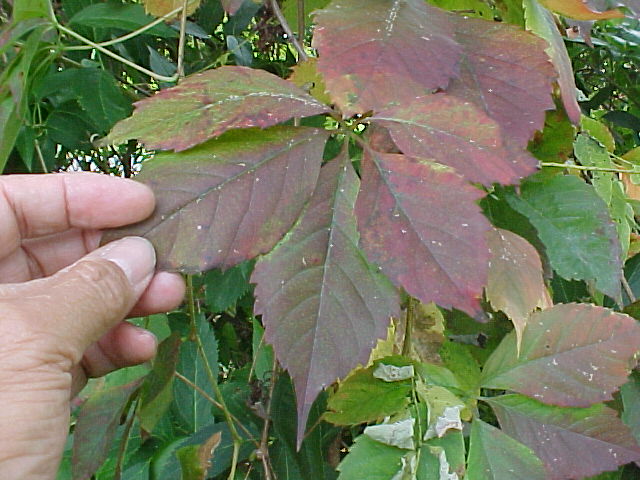
We had a chance to look at leaf color change and discuss what was going on. This cool example of how sunlight reacts with the chlorophyll can be found in our school yards right now - especially with ash trees and Virginia creeper (pictured here). Color change happens when the leaf stems shut down - nothing can get in, nothing can get out. The leaves can’t make chlorophyll, which gets used up making sugar. The sugar that’s made is trapped in the leaf. As the chlorophyll is used up other pigments that have been in the leaf all summer long but masked by the chlorophyll start to show through - carotenes and xanthophylls producing orange and yellow. The sugars react with the anthocyanin pigments and result is deep reds and purples.

What you want to look for is leave that overlay one another - this often shows up nicely with white ash trees or Virginia creeper vines. Move the leaves aside and you will find a green “shadow”. The green is from the chlorophyll that is still in the leaves since the sun was shaded by the overlap. Where the sun shone on the leaf the chlorophyll was used up to make sugar and reacts with the anthocyanin to show up reddish-purple.

A great book to get on leaf color changes is Autumn Leave: A Guide to the Fall Colors of the Northwoods by Ronald M. Lanner, published by Northwoods Press, Inc.

Wednesday, September 27, 2006

Ecologist-in-residence at Sapphire Elem School


I've just spent the last three days as an ecologist-in-residence at the Sapphire Elementary School in Harriman, NY. We explored the school grounds learning to be ecologists. We focused on questions that helped us to understand the living things of the school yard environment including - Who is who? What they do? Where they go? How they grow? Culminating our exploration we looked at the leaf litter habitat at the edge of a forest. We had discussed that the habitat provides creatures with FOOD, WATER and HIDING PLACES. So we were excited to find various beetles, spiders, centipedes, millipedes, worms, slugs, ants and other insects. One of the most interesting finds was a caterpillar, which I had to research to find out what kind is was. Pictured here is the caterpillar which is a Giant Leopard Moth Hypercompe scribonia. I looked this up in Caterpillars of Eastern North America: A Guide to Identification and Natural History byDavid L. Wagner.

Saturday, September 23, 2006

Hiking at Hawk Mountain

Today was my second annual hike on the AT to Pinnacle along the Kitaniny Ridge to enjoy the outdoors with a friend and catch glipse of hawks in migration. I had high hopes for a good day since the weather prediction were somewhat hopeful and on my way south through NJ on Friday I saw a kettle of about 100 broad-winged hawks. Unfortunately we woke up to intermittent rain, which did slightly clear up. So it was good hiking, a few sprinkles of rain but no hawks - on Pinnacle we were in the clouds with almost zero visibility. Already making plans for next year to catch the broad-wing migration with a hike to Pinnacle.

I'm piggybacking my trip to PA for hawks with a meeting with staff and parents at the Bushkill Elementary School in Nazareth, PA to plan an ecologist-in-residence program for winter. Had a chance to view the school yard for potential environmental education nature walks - plenty of deer tracks, goldenrods with ball galls and monarchs migrating by (they'll be long gone by January).

Right now the monarchs are very abundant - still quite a few caterpillars on milkweeds.