Earlier in February I visited the Piere van Cortlandt Middle School in Croton-On-Hudson. We did a survey of aquatic macroinvertebrates from pond water samples taken from a pond at the Landis Arboretum in Esperance, NY. These samples were taken from under the ice covering the pond which was about a foot thick.
Zabbia (first class first day), Ernau (second class first day), Dillon (third class first day), Barkan (first class second day), Herbert (second class second day), Liss (third class second day)
Waterboatmen - Dillon 1, Barkan 2, Herbert 3, Liss 1
Nematode - Dillon 3
Crawling Water Beetle - Ernau 3, Dillon 5, Barkan 3, Herbert 5, Liss 6
Dragonfly - Zabbia 34, Ernau 40, Dillon 39, Barkan 42, Herbert 31, Liss 35
Caddisfly - Zabbia 20, Ernau 27, Dillon 21, Barkan 18, Herbert 17, Liss 15
Backswimmer - Zabbia 4, Ernau 8, Dillon 8, Barkan 2, Herbert 8, Liss 6
Leech - Zabbia 5, Ernau 2, Dillon 3, Barkan 2, Herbert 2, Liss 2
Mayfly - Zabbia 16, Ernau 1, Dillon 1, Barkan 5
Bloodworm Midge - Zabbia 7, Ernau 11, Dillon 3, Barkan 5, Herbert 4
Freshwater Shrimp - Ernau 2, Dillon 2, Barkan 2
Giant Waterbug - Zabbia 4, Dillon 1, Barkan 1, Herbert 1
Cranefly - Dillon 1
Daphnia - Zabbia 1, Ernau 2, Dillon 1
Damselfly - Zabbia 10, Ernau 11, Dillon 4, Barkan 8, Herbert 7, Liss 3
Snail - Zabbia 2, Dillon 3, Barkan 3, Herbert 2, Liss 6
Water Pennies* - Ernau 1, Barkan 6,
Adalphia** - Barkan 1
Riffle Beetles*** - Barkan 2
Stonefly**** - Liss 1
* Water Pennies are the immature stage of the riffle beetles and occur only in streams. Since our samples came from a pond these wouldn’t be found there. I am not sure what creature may have been mistaken for a water penny.
** I think there was some confusion in the writing of the name “daphnia” which resulted in this entry.
*** Riffle beetles are found only in streams. The beetles identified as riffle beetles were most likely crawling water beetles.
**** Stoneflies occur mostly in streams or large lakes. They do not occur in the pond where our samples were taken. I suspect this specimen was really a damselfly.
In our first study of aquatic macroinvertebrates, the samples taken from the duck pond, we were doing a qualitative study. In a qualitative study we are looking at what kind of life occurs in that habitat. With this study we were looking for not only what is there but in what amounts. This would a quantitative study. Depending on what information a scientist is looking for they might do either studies.
I was interested in knowing how well 5th grade scientist might be at finding and identifying aquatic macroinvertebrates, a quantitative study. I wanted to know not only whether the 5th graders would find dragonflies, for example, but how many they would find. If the numbers of dragonflies found by the six classes varied widely I would then presume that there was wide range of ability at finding these creatures. In fact, students were quite capable at finding the macroinvertebrates, especially the larger size ones like damselflies, dragonflies and caddisflies.
As we did our investigation I began to wonder about the midge fly larvae, also called bloodworms. Several students observed bloodworms being eaten by dragonfly nymphs in the uncamouflage containers. It seems from the data that indeed they were being eaten since we found more of them on the first day (11 being the most and an average of 7 being found) as compared to the second day, where the most found was 5 with an average of 3. The bloodworm midges with their bright red color need a lot of hiding places. The investigation tubs must not have provided enough hiding places and they were being eaten.
As with any scientific work the more you do something the better you get at it. As beginning aquatic ecologist I am sure that there were some misidentifications made. For example I know that there was only one waterboatmen in all of the tubs. The waterboatmen look a lot like backswimmers. When I look at the data for waterboatmen I presume that the wide range in the number reported is a result of this misidentification. I’m sure that the extra waterboatmen were in fact backswimmers.
Mistakes in identification can be suspected if we analyze the data. Look at the giant waterbug data. Three classes found one giant waterbug, two found none and one found four. Again, with my experience, I know for sure that there was only one giant waterbug in our samples. When I analyze our findings I see that most teams, if they found a giant waterbug they found only one. I would suspect then that the class that found four likely misidentified the species and mistook some other organism for giant waterbugs.
When we look at most of the other creatures that were counted we see that we get very consistent numbers. In the cases where there was definitely some confusion in identification (the riffle beetles and stoneflies), the species that they likely were fit nicely into the numbers found by other students (the riffle beetles being crawling water beetles and the stonefly being a damselfly). This tells me that students were doing a good job in identifying most of the macroinvertebrates. There is one other species though, where I think there were some mistaken identities. Can you figure out which species this is?
From this data I conclude that 5th grade scientist with guidance, practice and experience a very capable of doing an inventory of aquatic macroinvertebrates. Even though some misidentification might occur the students did a great job in finding and identifying most of the aquatic organisms that we had in the sample tubs.
For more aquatic ecology investigations, including photos of some of the aquatic macroinvertebrates that might be seen in a freshwater pond see blog entry, Pond Ecology at Central Valley and Circleville, dated November 19, 2008.
Sunday, February 21, 2010


Wednesday, February 03, 2010
Jefferson Elementary School Owl Pellet Dissection
Here are the results for the owl pellet dissection that I did with the 5th grade ornithologists at the Jefferson Elementary School in Rotterdam, NY.
Gorski’s class – 12 pellets dissected, 28 mice, 1 shrew, 0 moles and 0 birds found
Guzewich’s class – 11 pellets dissected, 34 mice, 0 shrews, 0 moles and 0 birds found
Fiske’s class – 10 pellets dissected, 28 mice, 0 shrews, 0 moles and 1 bird found
Zanta’s class – 11 pellets dissected, 24 mice, 3 shrews, 0 moles and 0 birds found
Walker’s class – 10 pellets dissected, 24 mice, 2 shrews, 0 moles and 0 birds found
In our discussion we concluded that we could get a better understanding of what the owls eat if we took apart more pellets. Unfortunately time and money constraints didn’t allow us to take apart more pellets with each class. By looking at the data from all the classes though we are “taking apart more owl pellets”. What does this data tell us about owl food preference?
You can take this further if you can figure out how many pellets an owl might make in a night. This is what most likely happens. Starting at dusk an owl hunts and eats until it’s full. Then the owl finds a roosting place where it will rest, spit out a pellet and digest its food. This whole process might take a couple of hours. Then the owl will go off and hunt some more doing it all over again. Can you figure out how many pellets an owl might produce in a night? If you can, you can also figure out how many mice an owl might eat in a year.
Look through the blog for more owl pellet dissection entries. That would provide even more data to analyze and get a better understanding of owl prey preference.
Gorski’s class – 12 pellets dissected, 28 mice, 1 shrew, 0 moles and 0 birds found
Guzewich’s class – 11 pellets dissected, 34 mice, 0 shrews, 0 moles and 0 birds found
Fiske’s class – 10 pellets dissected, 28 mice, 0 shrews, 0 moles and 1 bird found
Zanta’s class – 11 pellets dissected, 24 mice, 3 shrews, 0 moles and 0 birds found
Walker’s class – 10 pellets dissected, 24 mice, 2 shrews, 0 moles and 0 birds found
In our discussion we concluded that we could get a better understanding of what the owls eat if we took apart more pellets. Unfortunately time and money constraints didn’t allow us to take apart more pellets with each class. By looking at the data from all the classes though we are “taking apart more owl pellets”. What does this data tell us about owl food preference?
You can take this further if you can figure out how many pellets an owl might make in a night. This is what most likely happens. Starting at dusk an owl hunts and eats until it’s full. Then the owl finds a roosting place where it will rest, spit out a pellet and digest its food. This whole process might take a couple of hours. Then the owl will go off and hunt some more doing it all over again. Can you figure out how many pellets an owl might produce in a night? If you can, you can also figure out how many mice an owl might eat in a year.
Look through the blog for more owl pellet dissection entries. That would provide even more data to analyze and get a better understanding of owl prey preference.
Thursday, January 28, 2010
Day 3 Owl Pellet Analysis at Nazareth Intermediate School
Here are the results for the third day of the Owl Ecology program for 4th graders at the Nazareth Intermediate School in Nazareth, PA.
Fatsinger’s class – 12 pellets dissected contained 23 mice, 2 shrew, 0 moles, 1 bird
Genua’s class – 13 pellets dissected contained 27 mice, 1 shrew, 0 moles, 0 birds
Reynolds’ class – 13 pellets dissected contained 28 mice, 9 shrews, 1 mole, 0 birds
DeBoer’s class – 13 pellets dissected contained 30 mice, 1 shrew, 0 moles, 0 birds
Reed’s class – 12 pellets dissected contained 27 mice, 0 shrew, 0 moles, 1 bird
A total of 63 pellets were dissected containing a total of 151 animals eaten by barn owls. That gives an average of 2.4 animals eaten per pellet. Compare this to data from previous owl pellet investigations described in this blog.
Fatsinger’s class – 12 pellets dissected contained 23 mice, 2 shrew, 0 moles, 1 bird
Genua’s class – 13 pellets dissected contained 27 mice, 1 shrew, 0 moles, 0 birds
Reynolds’ class – 13 pellets dissected contained 28 mice, 9 shrews, 1 mole, 0 birds
DeBoer’s class – 13 pellets dissected contained 30 mice, 1 shrew, 0 moles, 0 birds
Reed’s class – 12 pellets dissected contained 27 mice, 0 shrew, 0 moles, 1 bird
A total of 63 pellets were dissected containing a total of 151 animals eaten by barn owls. That gives an average of 2.4 animals eaten per pellet. Compare this to data from previous owl pellet investigations described in this blog.
Tuesday, January 26, 2010
Day 2 Owl Ecology Program at Nazareth I S
Here are the results for the second day of the Owl Ecology Program for 4th graders at the Nazareth Intermediate School in Nazareth, PA.
Giemza's class – 11 pellets dissected contained 25 mice, 1 shrew, 0 moles, 0 birds
Miller's class – 13 pellets dissected contained 31 mice, 2 shrews, 0 moles, 0 birds
Rohn's class – 13 pellets dissected contained 25 mice, 2 shrews, 0 moles, 3 birds
McCarron's class – 12 pellets dissected contained 29 mice, 1 shrew, 0 moles, 0 birds
A total of 49 pellets were dissected containing a total of 119 animals eaten by barn owls. That gives an average of 2.4 animals eaten per pellet. Compare this to data from previous owl pellet investigations described in the blog.
An interesting observation in Mrs. Rohn’s class. The three birds were found in one pellet. This was determined by the finding of three bird sternums, or breast bones (a bird sternum is keel shaped, not flat like a mammal sternum, with a bone sticking out perpendicular to the flat breast bone. This gives more muscles attachment points for the bird’s flight muscles). The breast bones were quite small, very likely from young birds. The owl must have found a bird nest with young in the nest and ate all of the young for its meal.
I will update our findings with tomorrow’s results.
Giemza's class – 11 pellets dissected contained 25 mice, 1 shrew, 0 moles, 0 birds
Miller's class – 13 pellets dissected contained 31 mice, 2 shrews, 0 moles, 0 birds
Rohn's class – 13 pellets dissected contained 25 mice, 2 shrews, 0 moles, 3 birds
McCarron's class – 12 pellets dissected contained 29 mice, 1 shrew, 0 moles, 0 birds
A total of 49 pellets were dissected containing a total of 119 animals eaten by barn owls. That gives an average of 2.4 animals eaten per pellet. Compare this to data from previous owl pellet investigations described in the blog.
An interesting observation in Mrs. Rohn’s class. The three birds were found in one pellet. This was determined by the finding of three bird sternums, or breast bones (a bird sternum is keel shaped, not flat like a mammal sternum, with a bone sticking out perpendicular to the flat breast bone. This gives more muscles attachment points for the bird’s flight muscles). The breast bones were quite small, very likely from young birds. The owl must have found a bird nest with young in the nest and ate all of the young for its meal.
I will update our findings with tomorrow’s results.
Monday, January 25, 2010
Owl Pellet Data from Nazareth IS 25 January 2010
Here are the results of the first day of the Owl Ecology program for 4th graders at the Nazareth Intermediate School in Nazareth, PA.
Kimble – 11 pellets dissected contained 26 mice, 1 shrew, 0 moles, 0 birds
Veleki – 12 pellets dissected contained 32 mice, 9 shrews, 1 mole, 0 birds
Thomas – 11 pellets dissected contained 30 mice, 3 shrews, 0 moles, 0 birds
Emrick – 12 pellets dissected contained 23 mice, 5 shrews, 0 moles, 0 birds
Roth – 12 pellets dissected contained 25 mice, 5 shrews, 1 mole, 0 birds
A total of 58 pellets were dissected containing a total of 161 animals eaten by barn owls. That gives an average of 2.8 animals eaten per pellet. Compare this to data from previous owl pellet investigations described in the blog.
I will update our findings with tomorrows results.
Kimble – 11 pellets dissected contained 26 mice, 1 shrew, 0 moles, 0 birds
Veleki – 12 pellets dissected contained 32 mice, 9 shrews, 1 mole, 0 birds
Thomas – 11 pellets dissected contained 30 mice, 3 shrews, 0 moles, 0 birds
Emrick – 12 pellets dissected contained 23 mice, 5 shrews, 0 moles, 0 birds
Roth – 12 pellets dissected contained 25 mice, 5 shrews, 1 mole, 0 birds
A total of 58 pellets were dissected containing a total of 161 animals eaten by barn owls. That gives an average of 2.8 animals eaten per pellet. Compare this to data from previous owl pellet investigations described in the blog.
I will update our findings with tomorrows results.
Thursday, November 05, 2009
Recycling at Circleville Elementary
I was able to convert the fifth grade classrooms at Circleville Elementary School into paper recycling factories. Each recycling engineer made a piece of paper board 10 inches in diameter from recycled newspaper and old homework sheets. In the process they learned how a paper recycling factory would work.
Leading up to the recycling activity was a discussion on trash. Why we need to do something about it and how we can start to lessen the amount of trash we produce. According to the Southeastern Public Service Authority, a solid waste management agency, the average person throws out about 6 pounds of trash per day. That adds up to more than a ton of trash that each of us ends up throwing out every year. What are we going to do with all this trash. Certainly not bury it all in someone's back yard!
Most people are familiar with the 3 “R’s” – Reduce, Reuse and Recycle (I’ve been hearing some talk about adding another “R” – Repair). They are listed that way on purpose. Reduce is the first thing that we should do to deal with our trash problem. Reuse and Recycle are the second and third thing we should be doing. I think most people know a lot about the second and third solutions but they don't know as much about the first, Reduce, and that's the one we should be doing the most. It's the one less understood and more difficult to accomplish.
What does Reduce mean as far as our trash is concerned (I once heard one of my environmental education camp counselors say reducing our trash meant to put it into a compactor and make it smaller. – unfortunately that is not what it means and really does nothing to solve the trash problem)? It really means that we do things so that there is less trash made to begin with. That’s what makes it more difficult to accomplish. Having less trash made means that we all have to make things and buys things differently. H ere’s a great example for students to consider.
Many of us like to eat junk food like potato chips, pretzels or cheese doodles. Here we see two different size packages that we can purchase. Buying one of these snacks creates more trash than buying the other. Which one results in more trash?
At first glance we’d think it's the bag on the right. Yes, it is smaller and when thrown away would be less trash than the package on the left (ah, you say “George, we can recycle it!” – yes it is plastic and theoretically recyclable, but in reality there isn’t a market or manufacturer that can do a business of recycling snack packages so even if you save the empty packages there’s no place to take them to be recycled) .
Let’s look deeper, though. If you got the package on the right for snack time and your mom or dad got the package on the left you’d cry out “Not fair!” Of course it wouldn’t be fair. Your dad or mom would end up with more snack. You would get 2 ounces of snack while your parents got 7 ounces (reading labels is very helpful).
Leading up to the recycling activity was a discussion on trash. Why we need to do something about it and how we can start to lessen the amount of trash we produce. According to the Southeastern Public Service Authority, a solid waste management agency, the average person throws out about 6 pounds of trash per day. That adds up to more than a ton of trash that each of us ends up throwing out every year. What are we going to do with all this trash. Certainly not bury it all in someone's back yard!
Most people are familiar with the 3 “R’s” – Reduce, Reuse and Recycle (I’ve been hearing some talk about adding another “R” – Repair). They are listed that way on purpose. Reduce is the first thing that we should do to deal with our trash problem. Reuse and Recycle are the second and third thing we should be doing. I think most people know a lot about the second and third solutions but they don't know as much about the first, Reduce, and that's the one we should be doing the most. It's the one less understood and more difficult to accomplish.
What does Reduce mean as far as our trash is concerned (I once heard one of my environmental education camp counselors say reducing our trash meant to put it into a compactor and make it smaller. – unfortunately that is not what it means and really does nothing to solve the trash problem)? It really means that we do things so that there is less trash made to begin with. That’s what makes it more difficult to accomplish. Having less trash made means that we all have to make things and buys things differently. H
 ere’s a great example for students to consider.
Many of us like to eat junk food like potato chips, pretzels or cheese doodles. Here we see two different size packages that we can purchase. Buying one of these snacks creates more trash than buying the other. Which one results in more trash?
At first glance we’d think it's the bag on the right. Yes, it is smaller and when thrown away would be less trash than the package on the left (ah, you say “George, we can recycle it!” – yes it is plastic and theoretically recyclable, but in reality there isn’t a market or manufacturer that can do a business of recycling snack packages so even if you save the empty packages there’s no place to take them to be recycled) .
Let’s look deeper, though. If you got the package on the right for snack time and your mom or dad got the package on the left you’d cry out “Not fair!” Of course it wouldn’t be fair. Your dad or mom would end up with more snack. You would get 2 ounces of snack while your parents got 7 ounces (reading labels is very helpful).


In order to make it fair you’d have to buy more of the small packages. How many more? You do the math and you'll see that it is two and a half packages. Oh, oh. You can’t buy two and half packages, so you end up buying three more packages for a total of four packages to get the same amount (actually a little more – which I’m sure wouldn't mind) as your parent.
What does this mean then as far the trash that you will throw into the garbage when you’re done eating the snacks. Let’s do the math; a large bag is 14 inches tall and 8 inches across. That means there would be 112 square inches of plastic going into the garbage. No, wait! There’d be twice that amount. Why? Because there are two pieces of plastic to make the bag, the piece in the front of the bag and the piece in the back. You’d be throwing into the garbage can 224 square inches of plastic.
Let’s look at the small bag. It measures 10 ½ inches tall and 5 ½ inches across which gives us an area of 57 ¾ square inches of plastic. Don’t forget we have to double that for the two pieces of plastic that make up the bag. So one of our little bags is 115 ½ square inches. But we have four of these small bags because we wanted to have the same amount of snacks as mom or dad. So we end up throwing into the trash can 462 square inches of plastic. Four hundred sixtytwo square inches is a lot more than 224 square inches!
Another way to think about this is to figure out (and it means more math) how much plastic there is for each ounce of snack. The large bag, 224 square inches, holds 7 ounces of snack. That means for every ounce of snack you’re throwing out 32 square inches of plastic. The smaller bag that holds 2 ounces is 115 ½ square inches. One ounce of snack from that bag would result in 57 ¾ square inches of plastic going into the trash. As they say, “You do the math!” When you do, you see that the big bag is better!
 As you can see in this picture it’s pretty obvious that the large bag ends up being less trash than a number of smaller bags that would have to be bought to give us the same amount of snack.
If we want to reduce the amount of trash we have to try to buy things that do not create more trash. To reduce the amount of plastic thrown into the garbage from snack bags means buying the snacks in large bags instead of small bags. That holds true for all kinds of packages; the larger size package has less packaging per unit volume than the small package.
Of course now mom and dad won’t let you bring the whole 7 ounce bag to school for snack. How will you solve that problem? Will your solution create more trash? Let me know.
What does this mean then as far the trash that you will throw into the garbage when you’re done eating the snacks. Let’s do the math; a large bag is 14 inches tall and 8 inches across. That means there would be 112 square inches of plastic going into the garbage. No, wait! There’d be twice that amount. Why? Because there are two pieces of plastic to make the bag, the piece in the front of the bag and the piece in the back. You’d be throwing into the garbage can 224 square inches of plastic.
Let’s look at the small bag. It measures 10 ½ inches tall and 5 ½ inches across which gives us an area of 57 ¾ square inches of plastic. Don’t forget we have to double that for the two pieces of plastic that make up the bag. So one of our little bags is 115 ½ square inches. But we have four of these small bags because we wanted to have the same amount of snacks as mom or dad. So we end up throwing into the trash can 462 square inches of plastic. Four hundred sixtytwo square inches is a lot more than 224 square inches!
Another way to think about this is to figure out (and it means more math) how much plastic there is for each ounce of snack. The large bag, 224 square inches, holds 7 ounces of snack. That means for every ounce of snack you’re throwing out 32 square inches of plastic. The smaller bag that holds 2 ounces is 115 ½ square inches. One ounce of snack from that bag would result in 57 ¾ square inches of plastic going into the trash. As they say, “You do the math!” When you do, you see that the big bag is better!
 As you can see in this picture it’s pretty obvious that the large bag ends up being less trash than a number of smaller bags that would have to be bought to give us the same amount of snack.
If we want to reduce the amount of trash we have to try to buy things that do not create more trash. To reduce the amount of plastic thrown into the garbage from snack bags means buying the snacks in large bags instead of small bags. That holds true for all kinds of packages; the larger size package has less packaging per unit volume than the small package.
Of course now mom and dad won’t let you bring the whole 7 ounce bag to school for snack. How will you solve that problem? Will your solution create more trash? Let me know.
Wednesday, November 04, 2009
Circleville 4th Grade Ornithologist Study Owls
Owl ecology is one my most popular studies. I always find it very interesting. From the feedback that I get I know the students that I share this with find it as interesting as I do.
I don’t know how many pellets I have dissected with students over the years. Pellets Inc., the company that I buy pellets from (see link to the right), says I’m one of their best customers. Each time I take apart pellets with elementary school ornithologists it is like a treasure hunt – even though I have an idea of what I might find, there are sometimes surprises.
One of the surprises this year with the pellets that I dissected with Circleville Elementary School 4th grade ornithologists was the number of bird skeletons that we found. Out of the 50 pellets that we dissected there were 4 bird skeletons. That might not seem like a lot but if we look at some other data that I have collected over the last few years we do find something unusual.
What’s unusual? Let’s look at the data. Not including what we dissected at Circleville, I have helped students take apart 251 pellets. In all of those pellets we found a total of 7 birds. How does that compare to what we found in our latest investigation? In order to compare we need to do some math. By doing an average we find that for every 36 pellets we dissected we discover 1 bird skeleton. In this recent investigation we found 1 bird skeleton for every 13 pellets. That’s a rate of twice as many birds eaten by owls in our sample compared to all of the pellets in my studies in the last few years.
Why? I don’t really know, but I do have several hypothesis. I do find that there are at times patterns in how and what the owls are eating. For example in the spring I find that many of the pellets have extremely crushed bones. In those cases, you will not find any whole skulls in the pellets. They will all have been crushed into small pieces. I suspect that these pellets come from young owls. The parents may crush the mice up with their beaks to make it easier for the young to eat. Or maybe the young, being smaller in size or not being very experienced eaters end up crushing the prey as they eat it, more so than older adult owls would. This may be showing us an eating behavior demonstrated by owls. Maybe there are patterns that help to explain what they eat.
One pattern that I have noticed is that if you do get some of the secondary prey (i.e. shrews, moles or birds) you will likely get several pellets in a batch with that kind of prey. Why? Well, there might be a couple of reasons for this. One is that individual owls, just like any other animal (including us), can sometimes have certain foods that they particularly like (for you or me, we might like to eat one particular thing, for example lima beans). If we ended up with pellets from an owl that has an unusual food favorite, then we might see a greater number of that kind of prey. Maybe a particular owl is really good at catching an unusual kind of prey. Again, if we got pellets from that owl we'd have a greater number of that unusual prey. When I purchase the pellets I buy them in bulk. It's likely that several of the pellets come from the same owl. In that case we might get a higher number than expected of the secondary prey. That might be the reason for why we found twice the usual rate for bird predation with our owl pellets - we happened to get pellets from an owl that was particularly fond of or particularly good at catching birds for food.
Another reason is that the unusual prey may be more abundant or more easily caught at certain times of the year, for example there may be more shrew nests in the spring providing for more chances for owls to find them. Often you will find four or five shrews skulls in one pellet, in that case I’m quite sure that the owl heard the shrews in the nest, dove down and grabbed that spot in the leaves and in one swoop catch a whole family of shrews for dinner. In the fall young birds begin to disperse from where they hatched and are no longer being cared for by their parents. These young, inexperienced birds might be more easily preyed upon by owls. This might be the reason why we had such a high number of bird prey in our investigation.
As you can see the web of life is very complex. There are many interconnections between predator and prey. Seasonal changes can affect the number and availability of food. The behavior of prey at different times of the year can make them more available for the owls. All of these things can affect what the owls eat. When we dissect their pellets we can get a glimpse of their world.
Here is the data from the pellets we dissected with 4th graders at Circleville Elementary School:
Mrs. Urmston’s class – 10 pellets, 23 mice, 0 shrew, 0 mole, 1 bird
Mrs. Przybocki’s class – 10 pellets, 24 mice, 4 shrews, 0 mole, 0 bird
Mrs. Conklin’s class – 10 pellets, 21 mice, 0 shrew, 0 mole, 0 bird
Mrs. Herb’s class – 10 pellets, 21 mice, 1 shrew, 0 mole, 2 bird
Mrs. Negron’s class – 10 pellets, 30 mice, 0 shrew, 0 mole, 1 bird
Here’s a question. Were the number of shrews eaten by the owls in our study sample typical or average for owls based on what my previous investigations have shown (hint – look at the number of shrews eaten in all of the dissections I have done with students and compare to what we found yesterday)? E-mail me your answer. Good luck.
I don’t know how many pellets I have dissected with students over the years. Pellets Inc., the company that I buy pellets from (see link to the right), says I’m one of their best customers. Each time I take apart pellets with elementary school ornithologists it is like a treasure hunt – even though I have an idea of what I might find, there are sometimes surprises.
One of the surprises this year with the pellets that I dissected with Circleville Elementary School 4th grade ornithologists was the number of bird skeletons that we found. Out of the 50 pellets that we dissected there were 4 bird skeletons. That might not seem like a lot but if we look at some other data that I have collected over the last few years we do find something unusual.
What’s unusual? Let’s look at the data. Not including what we dissected at Circleville, I have helped students take apart 251 pellets. In all of those pellets we found a total of 7 birds. How does that compare to what we found in our latest investigation? In order to compare we need to do some math. By doing an average we find that for every 36 pellets we dissected we discover 1 bird skeleton. In this recent investigation we found 1 bird skeleton for every 13 pellets. That’s a rate of twice as many birds eaten by owls in our sample compared to all of the pellets in my studies in the last few years.
Why? I don’t really know, but I do have several hypothesis. I do find that there are at times patterns in how and what the owls are eating. For example in the spring I find that many of the pellets have extremely crushed bones. In those cases, you will not find any whole skulls in the pellets. They will all have been crushed into small pieces. I suspect that these pellets come from young owls. The parents may crush the mice up with their beaks to make it easier for the young to eat. Or maybe the young, being smaller in size or not being very experienced eaters end up crushing the prey as they eat it, more so than older adult owls would. This may be showing us an eating behavior demonstrated by owls. Maybe there are patterns that help to explain what they eat.
One pattern that I have noticed is that if you do get some of the secondary prey (i.e. shrews, moles or birds) you will likely get several pellets in a batch with that kind of prey. Why? Well, there might be a couple of reasons for this. One is that individual owls, just like any other animal (including us), can sometimes have certain foods that they particularly like (for you or me, we might like to eat one particular thing, for example lima beans). If we ended up with pellets from an owl that has an unusual food favorite, then we might see a greater number of that kind of prey. Maybe a particular owl is really good at catching an unusual kind of prey. Again, if we got pellets from that owl we'd have a greater number of that unusual prey. When I purchase the pellets I buy them in bulk. It's likely that several of the pellets come from the same owl. In that case we might get a higher number than expected of the secondary prey. That might be the reason for why we found twice the usual rate for bird predation with our owl pellets - we happened to get pellets from an owl that was particularly fond of or particularly good at catching birds for food.
Another reason is that the unusual prey may be more abundant or more easily caught at certain times of the year, for example there may be more shrew nests in the spring providing for more chances for owls to find them. Often you will find four or five shrews skulls in one pellet, in that case I’m quite sure that the owl heard the shrews in the nest, dove down and grabbed that spot in the leaves and in one swoop catch a whole family of shrews for dinner. In the fall young birds begin to disperse from where they hatched and are no longer being cared for by their parents. These young, inexperienced birds might be more easily preyed upon by owls. This might be the reason why we had such a high number of bird prey in our investigation.
As you can see the web of life is very complex. There are many interconnections between predator and prey. Seasonal changes can affect the number and availability of food. The behavior of prey at different times of the year can make them more available for the owls. All of these things can affect what the owls eat. When we dissect their pellets we can get a glimpse of their world.
Here is the data from the pellets we dissected with 4th graders at Circleville Elementary School:
Mrs. Urmston’s class – 10 pellets, 23 mice, 0 shrew, 0 mole, 1 bird
Mrs. Przybocki’s class – 10 pellets, 24 mice, 4 shrews, 0 mole, 0 bird
Mrs. Conklin’s class – 10 pellets, 21 mice, 0 shrew, 0 mole, 0 bird
Mrs. Herb’s class – 10 pellets, 21 mice, 1 shrew, 0 mole, 2 bird
Mrs. Negron’s class – 10 pellets, 30 mice, 0 shrew, 0 mole, 1 bird
Here’s a question. Were the number of shrews eaten by the owls in our study sample typical or average for owls based on what my previous investigations have shown (hint – look at the number of shrews eaten in all of the dissections I have done with students and compare to what we found yesterday)? E-mail me your answer. Good luck.
Wednesday, October 21, 2009
Sprouting Acorns
As I’ve visited schools with my ecologist-in-residence program I’ve noticed some very good acorn crops, what ecologists would call mast. Some naturalists that I have talked with have noted that where they are there are fewer acorns. There seems to be a cycle of good acorn producing years then there are years with little acorn production. It would be interesting to note each year how the acorns are in your woods. If you keep a record of what you find you might note this cyclical change in acorn amounts.
At the Bell Top School in the East Greenbush Central School District there is a tremendous acorn crop this year. I’ve noticed that some of these acorns are already sprouting. These acorns come from the chestnut oaks.
These acorns gave me a chance to explore how seeds grow into trees with the students at Bell Top. I like to explain to them that a seed is really two things – a baby plant (in the case of the acorn, a baby oak tree) and the baby’s lunch box loaded with food packed away by the parent plant (in this case, the parent oak tree). I gathered up some of these sprouting acorns to investigate.

Many of the acorns, like this one, had yet to sprout.
At the Bell Top School in the East Greenbush Central School District there is a tremendous acorn crop this year. I’ve noticed that some of these acorns are already sprouting. These acorns come from the chestnut oaks.
These acorns gave me a chance to explore how seeds grow into trees with the students at Bell Top. I like to explain to them that a seed is really two things – a baby plant (in the case of the acorn, a baby oak tree) and the baby’s lunch box loaded with food packed away by the parent plant (in this case, the parent oak tree). I gathered up some of these sprouting acorns to investigate.

Many of the acorns, like this one, had yet to sprout.

Now and then, as we see here, we’d find one that had a small root beginning to break through the shell of the acorn. The first thing to grow on the young tree is this root. It's called a tap root.
Finding these sprouting acorns made for an excellent use of Billy B’s rhyme from Billy B Sings About Trees (see links to the right) –
The roots grow deep
Deep into the ground
Search for water
Drink it when it’s found

If you carefully cut open the acorn you can see the baby tree, what scientist would call the embryonic tree or growth. Look carefully here at tip of the pointer and you’ll see the embryonic tree, which is slightly discolored and tear shaped. All the rest of the acorn, the white material that fills up the bulk of the acorn is the food that the growing embryonic tree will need. This food was made in the green leaves of the parent tree – remember “Green Leaves Make Food!”
The root will use the food in the nut which is stored in what is called the cotyledons. There are two cotyledons in a oak seed. That’s why oak would be grouped with the dicots, plants with two cotyledons. As the oak seedling grows the cotyledons would form the beginnings of a shoot that would grow from the top of the root. As the cotyledons emerge they grow upward and take on a green color as they begin to produce chlorophyll. And not too soon, for as the food stored in the seed is about all used up the green portions of the shoot will start to produce food for the growing seedling. See my blog for pictures of a maple seedling showing this growth (click on May 2009 in the archives and go to May 24, 2009).
The roots grow deep
Deep into the ground
Search for water
Drink it when it’s found

If you carefully cut open the acorn you can see the baby tree, what scientist would call the embryonic tree or growth. Look carefully here at tip of the pointer and you’ll see the embryonic tree, which is slightly discolored and tear shaped. All the rest of the acorn, the white material that fills up the bulk of the acorn is the food that the growing embryonic tree will need. This food was made in the green leaves of the parent tree – remember “Green Leaves Make Food!”
The root will use the food in the nut which is stored in what is called the cotyledons. There are two cotyledons in a oak seed. That’s why oak would be grouped with the dicots, plants with two cotyledons. As the oak seedling grows the cotyledons would form the beginnings of a shoot that would grow from the top of the root. As the cotyledons emerge they grow upward and take on a green color as they begin to produce chlorophyll. And not too soon, for as the food stored in the seed is about all used up the green portions of the shoot will start to produce food for the growing seedling. See my blog for pictures of a maple seedling showing this growth (click on May 2009 in the archives and go to May 24, 2009).
Sunday, October 11, 2009
Skunk Scat at Bell Top
At Bell Top School with Mrs. O'Connell and her 3rd graders we discovered some scat on a culvert pipe cover. After doing some research using two books in particular (Mammal Tracks & Sign: A Guide to North American Species by Mark Elbroch and Tracking and the Art of Seeing: How to Read Animal Tracks and Sign by Paul Rezendes) my best guess is that it was from a skunk.
The photos in both books did not look exactly like the scat we found, pictured here. Nor did they look like the pictures of opossum scat. They were too small to be raccoon scat. In reading about the scat I found that skunk scat can be quite variable.

What has me thinking that the scat is likely skunk is that near by there are several places where there are holes dug in the ground by skunks. Skunks dig into the soil to feed on beetle grubs and other invertebrates that live there including yellow jackets. A good friend of mine, Rick Glatz, told me of a time he was doing a nature walk with students and they observed a skunk digging up a yellow jacket nest. The yellow jackets were swarming all around the skunk, yet the skunk continued to devour the nest oblivious to the insects trying to sting it.. Here is a picture of one of these holes from the Bell Top school yard where it was likely eating beetle grubs.

The photos in both books did not look exactly like the scat we found, pictured here. Nor did they look like the pictures of opossum scat. They were too small to be raccoon scat. In reading about the scat I found that skunk scat can be quite variable.

What has me thinking that the scat is likely skunk is that near by there are several places where there are holes dug in the ground by skunks. Skunks dig into the soil to feed on beetle grubs and other invertebrates that live there including yellow jackets. A good friend of mine, Rick Glatz, told me of a time he was doing a nature walk with students and they observed a skunk digging up a yellow jacket nest. The yellow jackets were swarming all around the skunk, yet the skunk continued to devour the nest oblivious to the insects trying to sting it.. Here is a picture of one of these holes from the Bell Top school yard where it was likely eating beetle grubs.

Here’s a song I learned years ago about a skunk.
The Skunk Song (sung to the tune of “Dixie”)
I stuck my head in a little skunk’s hole
The little skunk said “Oh bless my soul”
Take it out
Take it out
Take it out
Remove it!
Well I didn’t take it out and that little skunk said
If you don’t take it out you’ll wish you had
Take it out
Take it out
Take it out – psssssssssst
I removed it.
The Skunk Song (sung to the tune of “Dixie”)
I stuck my head in a little skunk’s hole
The little skunk said “Oh bless my soul”
Take it out
Take it out
Take it out
Remove it!
Well I didn’t take it out and that little skunk said
If you don’t take it out you’ll wish you had
Take it out
Take it out
Take it out – psssssssssst
I removed it.
In the song the skunk give three warnings – “Take it out, take it out, take it out”. In reading old accounts of skunks like those by Ernest Thompson Seton they tell of skunks giving three warnings when threatened by danger; the first, stomping their front feet on the ground; the second, making a hissing noise and showing their teeth; and finally, raising their tail. All of these are warning signs to ward off a predator. If successful, the predator leaves the skunk alone and the skunk doesn’t have to use any spray, thus conserving spray for when it really is needed.
I’ve always wondered if this was really true. I had a chance to check it out one day when I encountered a skunk at the Rogers Environmental Education Center in Sherburne, NY. It was a late winter day with mild weather and snow still on the ground. At that time of year skunks are starting to become more active moving about searching for food and getting ready for the mating season.
I was walking one of the Center’s trails when I saw a skunk near a corn crib wildlife feeding area. I was about 50 feet from it, a safe distance if the skunk were to spray. I decided to see if the skunk would give the three warnings. I made a snow ball and carefully tossed it toward the skunk. I missed by about 15 feet. The skunk gave no reaction and continued to slowly waddle along. To improve my accuracy I decided I had to get a little closer, made another snowball and tossed it. Again I missed (I wasn’t trying to hit the skunk, just trying to land the snowball near it), but by only 7 or 8 feet. The skunk just waddled along. So I got even close, less than 20 feet from the skunk, within spray range if it decided to let loose.
I tossed another snowball and almost hit the skunk on the head. It didn’t stomp the ground with it front feet. It didn’t hiss or bare its teeth. It stopped waddling and immediately raised its distinctively marked black and white tail. I thought, “Ooops!” and stood still. The skunk didn’t spray. After a few moments it began to slowly waddle along and then slowly lowered its tail. I slowly backed away.
I didn’t see any feet stomping, hissing or baring of teeth. I definitely saw the tail rise. The skunk had given me a warning. It worked! I left the skunk alone and it continued on with its business not having had to use any spray.
In hind sight it would have been interesting to have been sprayed. Then I could relate the experience of how the spray works – by causing eyes to water, irritation of the nose (I have had that experience when a skunk sprayed in the wood shed attached to our old farmhouse – the smell seeping into the house was so strong that it awoke me from my sleep with a burning sensation in my nose and watering eyes) and even vomiting.
One last note – notice the seeds in the scat. The large ones are cherry pits. The skunk, by feeding on cherry and other fruit, is helping to disperse those seeds. The fleshy part of the fruit is digested while the seed continues through the skunk’s digestive system. When the skunk goes to the bathroom they are planting trees and bushes far from the parent plant. Alas where this skunk went to the bathroom is a bad place for the seeds to have ended up in that they will not be able to grow on the metal plate.
I’ve always wondered if this was really true. I had a chance to check it out one day when I encountered a skunk at the Rogers Environmental Education Center in Sherburne, NY. It was a late winter day with mild weather and snow still on the ground. At that time of year skunks are starting to become more active moving about searching for food and getting ready for the mating season.
I was walking one of the Center’s trails when I saw a skunk near a corn crib wildlife feeding area. I was about 50 feet from it, a safe distance if the skunk were to spray. I decided to see if the skunk would give the three warnings. I made a snow ball and carefully tossed it toward the skunk. I missed by about 15 feet. The skunk gave no reaction and continued to slowly waddle along. To improve my accuracy I decided I had to get a little closer, made another snowball and tossed it. Again I missed (I wasn’t trying to hit the skunk, just trying to land the snowball near it), but by only 7 or 8 feet. The skunk just waddled along. So I got even close, less than 20 feet from the skunk, within spray range if it decided to let loose.
I tossed another snowball and almost hit the skunk on the head. It didn’t stomp the ground with it front feet. It didn’t hiss or bare its teeth. It stopped waddling and immediately raised its distinctively marked black and white tail. I thought, “Ooops!” and stood still. The skunk didn’t spray. After a few moments it began to slowly waddle along and then slowly lowered its tail. I slowly backed away.
I didn’t see any feet stomping, hissing or baring of teeth. I definitely saw the tail rise. The skunk had given me a warning. It worked! I left the skunk alone and it continued on with its business not having had to use any spray.
In hind sight it would have been interesting to have been sprayed. Then I could relate the experience of how the spray works – by causing eyes to water, irritation of the nose (I have had that experience when a skunk sprayed in the wood shed attached to our old farmhouse – the smell seeping into the house was so strong that it awoke me from my sleep with a burning sensation in my nose and watering eyes) and even vomiting.
One last note – notice the seeds in the scat. The large ones are cherry pits. The skunk, by feeding on cherry and other fruit, is helping to disperse those seeds. The fleshy part of the fruit is digested while the seed continues through the skunk’s digestive system. When the skunk goes to the bathroom they are planting trees and bushes far from the parent plant. Alas where this skunk went to the bathroom is a bad place for the seeds to have ended up in that they will not be able to grow on the metal plate.
Saturday, October 03, 2009
Caterpillar at Sapphire Elementary
I’ve just finished up my fall visit at the Sapphire Elementary School in Monroe, NY. Kindergarten and 1st graders had the chance to be ecologists with me exploring the schoolyard ecosystem. Our trips into the lawn and forest edge revealed many different plants and animals. We found the typical herbaceous plants of the schoolyard lawn – red and white clovers, dandelion, crab grass along with a number of other grass species, yarrow, common and English plantain and trees – red, sugar and Norway maples, Norway spruce and white ash.
Several classes had the opportunity to see a variety of different birds. Blue jays and turkey vultures were seen by almost all the classes. One class had the opportunity to observe about a dozen Eastern bluebirds flit about a schoolyard fence and nearby power line. At one point we saw a male fly up from the ground and land on the wire with a caterpillar or worm in its mouth. Another group witnessed three broad-winged hawks and two osprey fly by on migration. Missing from the usual creatures observed on these autumn field trips was the monarch butterfly. In past years several dozen monarchs would be observed on our walks. This year we only saw two. We wondered what might have caused this decline in monarchs, something that has been observed and talked about by other naturalists and environmental educators throughout the state.
Late summer and fall is a great time to observe caterpillars. They have spent the summer months growing up and their larger size makes them easily visible as they prepare to overwinter. The wooly bear is probably the most familiar of the fall caterpillars but there are many other candidates to discover. We encountered one such caterpillar, one that I had never seen before. I had to tell the students that I didn’t know what it was and that I would have to do some research to figure it out.
 Using “Caterpillars of Eastern North America” I was able to figure out that the caterpillar, shown here, was a Ruby Tiger Moth. It’s scientific name is Pragmatobia fuliginosa, a relative of the Wooly Bear (Isia isabella) in the moth family called Arctiidae. The caterpillar eats a lot of different plants including goldenrod, plantain, sunflowers and ash - there are ash trees and plantain in the Sapphire Elementary schoolyard.
The caterpillar will hibernate for the winter and form a cocoon in the spring. The adult moth will come out of the cocoon after it has undergone metamorphosis. It's body will be a dark reddish brown with a row of black spots along the back of its abdomen. The front wings will be a dull reddish brown with one small black spot on each wing. The hind wings will be a pale pink, also with one small dark spot on each wing.
Other caterpillars I’ve come across in my travels include the Galium Sphinx (Hyles gallii) and Trumpet Vine Sphinx (Paratraea plebeja).


Here are two caterpillars that I found recently (this past late summer and fall) in my travels but have not been able to figure out what species they are. Do you know what they are?


Keep your eyes open for caterpillars in the schoolyard. The big brightly colored ones provide a great hands-on teaching opportunity about the diversity of life in the schoolyard, life cycles, food chains, animal behavior, and adaptations.
Several classes had the opportunity to see a variety of different birds. Blue jays and turkey vultures were seen by almost all the classes. One class had the opportunity to observe about a dozen Eastern bluebirds flit about a schoolyard fence and nearby power line. At one point we saw a male fly up from the ground and land on the wire with a caterpillar or worm in its mouth. Another group witnessed three broad-winged hawks and two osprey fly by on migration. Missing from the usual creatures observed on these autumn field trips was the monarch butterfly. In past years several dozen monarchs would be observed on our walks. This year we only saw two. We wondered what might have caused this decline in monarchs, something that has been observed and talked about by other naturalists and environmental educators throughout the state.
Late summer and fall is a great time to observe caterpillars. They have spent the summer months growing up and their larger size makes them easily visible as they prepare to overwinter. The wooly bear is probably the most familiar of the fall caterpillars but there are many other candidates to discover. We encountered one such caterpillar, one that I had never seen before. I had to tell the students that I didn’t know what it was and that I would have to do some research to figure it out.
 Using “Caterpillars of Eastern North America” I was able to figure out that the caterpillar, shown here, was a Ruby Tiger Moth. It’s scientific name is Pragmatobia fuliginosa, a relative of the Wooly Bear (Isia isabella) in the moth family called Arctiidae. The caterpillar eats a lot of different plants including goldenrod, plantain, sunflowers and ash - there are ash trees and plantain in the Sapphire Elementary schoolyard.
The caterpillar will hibernate for the winter and form a cocoon in the spring. The adult moth will come out of the cocoon after it has undergone metamorphosis. It's body will be a dark reddish brown with a row of black spots along the back of its abdomen. The front wings will be a dull reddish brown with one small black spot on each wing. The hind wings will be a pale pink, also with one small dark spot on each wing.
Other caterpillars I’ve come across in my travels include the Galium Sphinx (Hyles gallii) and Trumpet Vine Sphinx (Paratraea plebeja).


Here are two caterpillars that I found recently (this past late summer and fall) in my travels but have not been able to figure out what species they are. Do you know what they are?


Keep your eyes open for caterpillars in the schoolyard. The big brightly colored ones provide a great hands-on teaching opportunity about the diversity of life in the schoolyard, life cycles, food chains, animal behavior, and adaptations.
Tuesday, September 29, 2009
Fall Seeds
My apologies to Mr. Rawitsch and the 1st grade classes at Glenmont Elementary for this late entry in my blog. Thank you, Mr. Rawitsch, for the pictures here. I hope that you and the first grade teachers and students enjoy it even though it is late – better late than never?!?
Autumn is a great time to explore seeds in the outdoor science laboratory that is a school yard. At Glenmont I had the chance to take the 1st grades outside to what they call the Big Backyard (and what I call my outdoor science laboratory) to look for and learn about seeds. An easy task, since in the fall seeds are just about everywhere.

Our exploration started with looking at the different parts of plants. One of the most obvious parts of plants are the leaves. And what do leaves do? “Green Leaves Make Food” was our chanted response to that question. The food made by the leaves is used by the plant to help all the parts of the plant to grow. Some of that food remains in the leaf and is eaten, like this grape (Vitis species) leaf we found that had been eaten by Japanese beetles (Popillia japonica). Do the leaves become the seeds? No.

We then looked at the roots of plants, in this case, crab grass (Digitaria genus). What do roots do? Well we borrowed a rhyme from Billy B (see the Billy "B" link) to help us remember – “The roots grow deep, deep into the ground, search for water, drink it when it’s found”. Do the roots become seeds? No.
Neither do the stems or branches. So what does turn into the seeds? Flower turn into seeds. That became our chant – “Flowers turn into seeds!” How do flowers turn into seeds? Well they need to be pollinated. Many flowers are pollinated by insects and other small animals. The flower colors and smell attract these creatures. It’s as if the flowers were saying, “Eat here. Eat here. Eat here.” When the insects visit for a meal of nectar and pollen they spread some of the pollen to parts of the flower that will grow into seeds. We call this pollination. We found some flower buds for bittersweet nightshade (Solanum dulcamara). Right on the same vine we found nightshade fruit. Fruits are a seed container.


Looking at the nightshade leaves, flower and fruit we could see t hat it looked a bit like tomatoes. That’s because nightshade is related to tomatoes and potatoes. They all belong in a group that scientist call a family. The name of this family is Solanaceae. Although they belong in the same family as tomatoes and potatoes, nightshade fruit are poisonous to people. Since nightshade is similar to tomatoes we wondered if they would have as many seeds as a tomato does. We found out by squishing open a nightshade fruit. The fruits we opened had about 20 to 30 seeds in them – lots of seeds in a fruit just like tomatoes.
Brightly colored fruits lik e the nightshade and grape attract animals. Their colors say to the animals “Eat me!” Here we see a grape that we’ve squished open. Inside the grape we found several seeds. While the juices and fleshy parts of the fruit are digested in the animal’s stomach the seeds would continue to travel through the animal’s digestive system. It would eventually be deposited somewhere when the animal goes to the bathroom. If the seeds end up where there is plenty of soil, water and sunlight it might grow into a plant far from the parent plant. The plant has helped out the animal by providing food. The animal helps the plant out by spreading plant seeds about the environment.
Here is a cherry (Prunus species) seed that was deposited on a wooden fence in the school yard. It probably got there by traveling in a bird’s digestive system. Not all seeds travel inside animals. What other ways might a seed be dispersed?
So much to learn about seeds, right outside the school doors, in the science laboratory that is the schoolyard!
Autumn is a great time to explore seeds in the outdoor science laboratory that is a school yard. At Glenmont I had the chance to take the 1st grades outside to what they call the Big Backyard (and what I call my outdoor science laboratory) to look for and learn about seeds. An easy task, since in the fall seeds are just about everywhere.


Our exploration started with looking at the different parts of plants. One of the most obvious parts of plants are the leaves. And what do leaves do? “Green Leaves Make Food” was our chanted response to that question. The food made by the leaves is used by the plant to help all the parts of the plant to grow. Some of that food remains in the leaf and is eaten, like this grape (Vitis species) leaf we found that had been eaten by Japanese beetles (Popillia japonica). Do the leaves become the seeds? No.

We then looked at the roots of plants, in this case, crab grass (Digitaria genus). What do roots do? Well we borrowed a rhyme from Billy B (see the Billy "B" link) to help us remember – “The roots grow deep, deep into the ground, search for water, drink it when it’s found”. Do the roots become seeds? No.
Neither do the stems or branches. So what does turn into the seeds? Flower turn into seeds. That became our chant – “Flowers turn into seeds!” How do flowers turn into seeds? Well they need to be pollinated. Many flowers are pollinated by insects and other small animals. The flower colors and smell attract these creatures. It’s as if the flowers were saying, “Eat here. Eat here. Eat here.” When the insects visit for a meal of nectar and pollen they spread some of the pollen to parts of the flower that will grow into seeds. We call this pollination. We found some flower buds for bittersweet nightshade (Solanum dulcamara). Right on the same vine we found nightshade fruit. Fruits are a seed container.


Looking at the nightshade leaves, flower and fruit we could see t
 hat it looked a bit like tomatoes. That’s because nightshade is related to tomatoes and potatoes. They all belong in a group that scientist call a family. The name of this family is Solanaceae. Although they belong in the same family as tomatoes and potatoes, nightshade fruit are poisonous to people. Since nightshade is similar to tomatoes we wondered if they would have as many seeds as a tomato does. We found out by squishing open a nightshade fruit. The fruits we opened had about 20 to 30 seeds in them – lots of seeds in a fruit just like tomatoes.
Brightly colored fruits lik
 e the nightshade and grape attract animals. Their colors say to the animals “Eat me!” Here we see a grape that we’ve squished open. Inside the grape we found several seeds. While the juices and fleshy parts of the fruit are digested in the animal’s stomach the seeds would continue to travel through the animal’s digestive system. It would eventually be deposited somewhere when the animal goes to the bathroom. If the seeds end up where there is plenty of soil, water and sunlight it might grow into a plant far from the parent plant. The plant has helped out the animal by providing food. The animal helps the plant out by spreading plant seeds about the environment.
Here is a cherry (Prunus species) seed that was deposited on a wooden fence in the school yard. It probably got there by traveling in a bird’s digestive system. Not all seeds travel inside animals. What other ways might a seed be dispersed?
So much to learn about seeds, right outside the school doors, in the science laboratory that is the schoolyard!
Wednesday, August 12, 2009
Organisms That We've Observed
Our RSSE adventures have led us to a variety of encounters with different organisms. One of these is the Cicada exoskeletons that many of the Young Naturalists have been finding. These are the Dog Day Cicadas that you hear buzzing in the trees during the day. These insects are about a year old and have spent most of their lives underground. They hatched last August or September from eggs that were laid in the tips of tree branches. After hatching they dropped out of the tree and tunneled into the soil where they lived, surviving on plant juices that they sucked out of roots until coming out from their underground home in the last few weeks. When they crawled out of the ground they climbed up tree trunks, fence posts and other objects where they shed their exoskeleton and emerged with wings. They have flown up into the trees where they buzz to attract mates.
On the early morning bird walk we saw or heard 7 species of birds including House Sparrow, American Crow, Starling, Catbird, Rock Pigeon, American Goldfinch and Northern Cardinal. But the most exciting find was a young Woodchuck. Many people know the Woodchuck as a Ground Hog, but it has many other names including Whistle Pig and Marmot. Some one even mentioned that there is a Pennsylvania Dutch name for them but they couldn’t remember what it was. Since animals like the Woodchuck often do have so many common names, scientist will use the scientific name to be sure that other scientist are clear about what animal they are talking about. The scientific name for the Woodchuck is Marmota monax.
On the early morning bird walk we saw or heard 7 species of birds including House Sparrow, American Crow, Starling, Catbird, Rock Pigeon, American Goldfinch and Northern Cardinal. But the most exciting find was a young Woodchuck. Many people know the Woodchuck as a Ground Hog, but it has many other names including Whistle Pig and Marmot. Some one even mentioned that there is a Pennsylvania Dutch name for them but they couldn’t remember what it was. Since animals like the Woodchuck often do have so many common names, scientist will use the scientific name to be sure that other scientist are clear about what animal they are talking about. The scientific name for the Woodchuck is Marmota monax.

Another cool organism that we’ve encountered is the Bird Nest Fungus. It is growing in several places under the trees along the sidewalk in front of the Williams Center. As you can see from the photos I took the fungus’ fruiting body is smaller than a penny. The majority of the fungus though is the fungal mycelia that grows under the wood chips and eats up the food energy stored in the dead wood. Look carefully inside the fungal cup and you’ll see some little lumps that make the whole body look like a miniature bird nest complete with tiny eggs – hence the name Bird Nest Fungus. When rain water splashes into the cup fungal spore are propelled out to spread about and grow into new fungi.

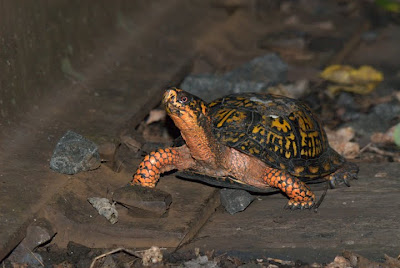
But the most exciting organism discovered in our ramblings so far, I think, has been the Box Turtle, Terrapene Carolina. Thanks to Sarah Ye for the wonderful pictures of the turtle posted here.


Bird House
Whew! What a day – from bald eagles to insects. The bird nest box work was super! I wish I had a chance to check out the owl pellet analysis and fish printing.
The nest boxes we built are designed for the Eastern Bluebird. The size of the hole keeps birds like House Sparrows and Starlings from using the box. Both of these birds are invasive alien species (they both were released in America by people interested in having animals mentioned in Shakespeare live among us – they are originally from Europe) that out competed Bluebirds for tree holes – their natural nesting place. As far as the Bluebird is concerned the bird house is just a hole in a tree!
To attract Bluebirds the box should be placed in an open field area that is mowed now and then – lawns are fine. Very tall grass can affect the birds’ ability to find ground living insects, especially caterpillars. Placing the nest box too close to the edge of woods or brushy areas invites the House Wren to use the nest box to the detriment of the Bluebird. The House Wren might even bury the Bluebird nestlings or eggs under a pile of sticks as they fill up the box to prevent any other Wrens from using it and encroaching on their own territory.
There are several other birds that might use the nest box. In addition to the House Wren, the Black-capped Chickadee, Tufted Titmouse, Nuthatch and Tree Swallow might use the bird house. In fact many people set up nest boxes in pairs with one about 20 feet apart from the other. If a Tree Swallow occupies one of the boxes, it will not allow another Tree Swallow family to move into the second box, thus leaving it open for Bluebirds. They don’t care if Bluebirds move in and raise a family.
The nest boxes we built are designed to have a front door that can swing up to allow access to the inside of the box. Most of the boxes were constructed so that the doors had a snug fit. If the door is loose enough to open without much force you might add a latching mechanism to the box. The easiest way to do this is to drill a hole through one of the side walls so that the hole also drills into the front door. Place a nail that fits snuggly into the hole (without the need for pounding it with a hammer) so that it penetrates all the way into the door. The box should be opened for periodical checks to be sure that wasps do not start nesting in the box – this can be disturbing to the nesting birds. If you find a wasp nest carefully scrape it out of the box. Don’t use insect sprays on the wasps. The spray chemicals will not be good for the birds using the box. You don’t have to worry about your human smell causing trouble for the birds. Most birds can’t smell very well, so what ever smell you’ve left behind they can’t smell it. More importantly their instinct to care for their young is so strong that even if they know that you have been there, once you go they will return to take care of their babies.
The other reason to open the nest box is to clean out the old nest so that returning birds will have any empty “hole” to use. The box should be cleaned out in late winter. When cleaning out the nest box you might find that it has served as the home for mice like the White-footed Mouse or Deer Mouse, or a Flying Squirrel.
Good luck with your nest box. I hope that you get a bird family to move in.
The nest boxes we built are designed for the Eastern Bluebird. The size of the hole keeps birds like House Sparrows and Starlings from using the box. Both of these birds are invasive alien species (they both were released in America by people interested in having animals mentioned in Shakespeare live among us – they are originally from Europe) that out competed Bluebirds for tree holes – their natural nesting place. As far as the Bluebird is concerned the bird house is just a hole in a tree!
To attract Bluebirds the box should be placed in an open field area that is mowed now and then – lawns are fine. Very tall grass can affect the birds’ ability to find ground living insects, especially caterpillars. Placing the nest box too close to the edge of woods or brushy areas invites the House Wren to use the nest box to the detriment of the Bluebird. The House Wren might even bury the Bluebird nestlings or eggs under a pile of sticks as they fill up the box to prevent any other Wrens from using it and encroaching on their own territory.
There are several other birds that might use the nest box. In addition to the House Wren, the Black-capped Chickadee, Tufted Titmouse, Nuthatch and Tree Swallow might use the bird house. In fact many people set up nest boxes in pairs with one about 20 feet apart from the other. If a Tree Swallow occupies one of the boxes, it will not allow another Tree Swallow family to move into the second box, thus leaving it open for Bluebirds. They don’t care if Bluebirds move in and raise a family.
The nest boxes we built are designed to have a front door that can swing up to allow access to the inside of the box. Most of the boxes were constructed so that the doors had a snug fit. If the door is loose enough to open without much force you might add a latching mechanism to the box. The easiest way to do this is to drill a hole through one of the side walls so that the hole also drills into the front door. Place a nail that fits snuggly into the hole (without the need for pounding it with a hammer) so that it penetrates all the way into the door. The box should be opened for periodical checks to be sure that wasps do not start nesting in the box – this can be disturbing to the nesting birds. If you find a wasp nest carefully scrape it out of the box. Don’t use insect sprays on the wasps. The spray chemicals will not be good for the birds using the box. You don’t have to worry about your human smell causing trouble for the birds. Most birds can’t smell very well, so what ever smell you’ve left behind they can’t smell it. More importantly their instinct to care for their young is so strong that even if they know that you have been there, once you go they will return to take care of their babies.
The other reason to open the nest box is to clean out the old nest so that returning birds will have any empty “hole” to use. The box should be cleaned out in late winter. When cleaning out the nest box you might find that it has served as the home for mice like the White-footed Mouse or Deer Mouse, or a Flying Squirrel.
Good luck with your nest box. I hope that you get a bird family to move in.
Monday, August 10, 2009
The First Day for the 2009 RSSE at Lafayette College
What a day! What a wonderful bunch of young naturalists – so full of excitement, enthusiasm and sense of wonder. Terrific parents, too, and fantastic adult and youth volunteer helpers!
My highlight for the day was the box turtle we found at Monacacy Park. Best part was that it was spotted by some of the young naturalist. One of the parents captured it for me and I had a great chance to talk about a somewhat rare turtle, not endangered, but one who’s numbers have declined. It was male about 25 to 30 years old – you can tell their age by counting the rings on the scutes, or scales on the shell on their back.
It was great to see all the bats, especially with me coming from New York State were there has been quite a problem with loss of bats to the white nose syndrome. The bat sound translator worked very well and we all got a chance to hear the ultrasonic bat sounds, both their navigating sounds and their hunting/targeting sounds. It was also exciting to have the bats eventually start flying right over our heads, seeking out insects that were probably attracted to all of us humans.
I was quite intrigued by the fact that there were still fireflies (you can also call them lightning bugs, but remember they are neither flies nor bugs, but actually beetles) flying and flashing about this late in the summer. I usually expect to see them in June and perhaps early July. I wonder if the cool rainy weather we’ve had this summer has anything to do with that. I also wonder if the cool rainy summer has anything to do with the lack of jewel weed seed pods – there definitely were very few seeds pods to pick and show their exploding characteristic – jewel weed, also called touch-me-nots (a name given for that exploding attribute) have seed pods that pop when disturbed thus casting their seeds about helping the young plants to spread out.
I also enjoyed the Pond Ecology session. It’s always exciting to find what creatures are in the pond environment. It is always changing as populations of organisms rise and fall; generations grow up, leave the pond, then later return to lay eggs and start the cycle all over again. Check out my blog in the archive for November 2008 for some photos and more information on Aquatic Macro-invertebrates. I’m wondering if any young naturalist will take up my challenge to video the aquatic worm doing it wiggle swim and set the video to some techno/electronic beat.
I’m hoping many of the young naturalists will be able to use the mammal skull key that we learned about to identify mammal skulls that they may find in the future. I’m looking forward to talking more about mammal bones and getting the chance for the scientists to investigate my collection of bones, perhaps sketching them and identifying what bones they are by comparing them to our own human bones. – ah, a little comparative anatomy.
You might be wondering about what some of these organisms look like – jewel weed, box turtle, aquatic macro invertebrates – check out my blog for October 2nd, 2006 for a run down on my favorite guide books and natural history resources.
My highlight for the day was the box turtle we found at Monacacy Park. Best part was that it was spotted by some of the young naturalist. One of the parents captured it for me and I had a great chance to talk about a somewhat rare turtle, not endangered, but one who’s numbers have declined. It was male about 25 to 30 years old – you can tell their age by counting the rings on the scutes, or scales on the shell on their back.
It was great to see all the bats, especially with me coming from New York State were there has been quite a problem with loss of bats to the white nose syndrome. The bat sound translator worked very well and we all got a chance to hear the ultrasonic bat sounds, both their navigating sounds and their hunting/targeting sounds. It was also exciting to have the bats eventually start flying right over our heads, seeking out insects that were probably attracted to all of us humans.
I was quite intrigued by the fact that there were still fireflies (you can also call them lightning bugs, but remember they are neither flies nor bugs, but actually beetles) flying and flashing about this late in the summer. I usually expect to see them in June and perhaps early July. I wonder if the cool rainy weather we’ve had this summer has anything to do with that. I also wonder if the cool rainy summer has anything to do with the lack of jewel weed seed pods – there definitely were very few seeds pods to pick and show their exploding characteristic – jewel weed, also called touch-me-nots (a name given for that exploding attribute) have seed pods that pop when disturbed thus casting their seeds about helping the young plants to spread out.
I also enjoyed the Pond Ecology session. It’s always exciting to find what creatures are in the pond environment. It is always changing as populations of organisms rise and fall; generations grow up, leave the pond, then later return to lay eggs and start the cycle all over again. Check out my blog in the archive for November 2008 for some photos and more information on Aquatic Macro-invertebrates. I’m wondering if any young naturalist will take up my challenge to video the aquatic worm doing it wiggle swim and set the video to some techno/electronic beat.
I’m hoping many of the young naturalists will be able to use the mammal skull key that we learned about to identify mammal skulls that they may find in the future. I’m looking forward to talking more about mammal bones and getting the chance for the scientists to investigate my collection of bones, perhaps sketching them and identifying what bones they are by comparing them to our own human bones. – ah, a little comparative anatomy.
You might be wondering about what some of these organisms look like – jewel weed, box turtle, aquatic macro invertebrates – check out my blog for October 2nd, 2006 for a run down on my favorite guide books and natural history resources.
Thursday, July 02, 2009
Camp Gross Staff Training
Camp Gross Camp Staff Training Session
July 1, 2009
Four guiding principles for being a camp counselor (and for working with children in all different situations)
Children like to Move and Make Noise – When I first heard Bill Brennan (see Billy “B”) say this in a workshop on song writing, singing and movement for working with children it struck a chord in me. It articulated what I knew from my years of experience in working with children. Children like to move and make noise. As a camp counselor or youth leader my job isn’t to stop children from moving and making noise, it’s to help them move and make noise in the direction needed. As a youth leader am I prepared to do this?
Children Do Not Have A Short Attention Span – Think back to the sage advise given to us by someone (your mom, a teacher, a camp program director) when we first started working with children, “Remember, kids have a short attention span.” Well, this advice is was WRONG (actually not wrong just misdirected). Years ago when I heard a presentation by Michael Brandwein speaking on the attention span of children, he spoke about youth leaders needing to have good attention grabbers. Again, this is something that I had known all along from experience. Saying children have a short attention span doesn’t help me do my job as a youth leader. It lays the problem on the children, when the problem is really what do I have that will help me capture the attention of the children I am working with. Children have an attention span, sometimes short other times long. I need tips, tricks, techniques that will help me keep that child’s attention on the situation at hand instead of on something else.
Just Do It – I wish I had trademarked this phrase when I first started using it while advising and training camp counselors, youth leaders and teachers years before it was made popular by a Nike ad campaign. Too many times we spend too much time talking to children, instead of letting them “Just Do It”. Children don’t need to know everything before they start on something. They learn by doing. As a camp counselor, more doing is much better than more talking.
Everything I Do Teaches – This is a personal philosophy that goes much beyond just being a camp counselor. In today’s world everyone points to all the negative influences – TV, celebrities, the media, politicians, investment bankers – that affect the development of children. Well, where are the positive influences going to come from, from you and me. Hillary Rodham Clinton made this African folk phrase “It takes a village” popular a few years back. What makes up that village? Individuals do. Everything you do teaches those around you. As a camp counselor this is the most important thing to remember, you may say one thing but if you do another your actions will teach much better than your words.
With these four principles in mind what tips, tricks, and techniques will I have at the ready as a youth leader to help me in my work with children. Here is a list of games, activities, challenges, puzzles and presentations that I shared with the Camp Gross staff.
What is it Bag (also known as a Grock Bag)
Rope Circle
Circle Pass Games
Magic Sticks
Suns and Planets
Finger on the Nose Trick
Move That Finger
Sharp Eyes
ESP
Nail Balance Challenge
Fork Balance Challenge
Pick Up the Straws Challenge
Crook of the Elbow
Maze
These activities come from a wide range of resources and experiences. I’ll blog about these later.
If you want to know details of how to do any of the activities e-mail me.
July 1, 2009
Four guiding principles for being a camp counselor (and for working with children in all different situations)
Children like to Move and Make Noise – When I first heard Bill Brennan (see Billy “B”) say this in a workshop on song writing, singing and movement for working with children it struck a chord in me. It articulated what I knew from my years of experience in working with children. Children like to move and make noise. As a camp counselor or youth leader my job isn’t to stop children from moving and making noise, it’s to help them move and make noise in the direction needed. As a youth leader am I prepared to do this?
Children Do Not Have A Short Attention Span – Think back to the sage advise given to us by someone (your mom, a teacher, a camp program director) when we first started working with children, “Remember, kids have a short attention span.” Well, this advice is was WRONG (actually not wrong just misdirected). Years ago when I heard a presentation by Michael Brandwein speaking on the attention span of children, he spoke about youth leaders needing to have good attention grabbers. Again, this is something that I had known all along from experience. Saying children have a short attention span doesn’t help me do my job as a youth leader. It lays the problem on the children, when the problem is really what do I have that will help me capture the attention of the children I am working with. Children have an attention span, sometimes short other times long. I need tips, tricks, techniques that will help me keep that child’s attention on the situation at hand instead of on something else.
Just Do It – I wish I had trademarked this phrase when I first started using it while advising and training camp counselors, youth leaders and teachers years before it was made popular by a Nike ad campaign. Too many times we spend too much time talking to children, instead of letting them “Just Do It”. Children don’t need to know everything before they start on something. They learn by doing. As a camp counselor, more doing is much better than more talking.
Everything I Do Teaches – This is a personal philosophy that goes much beyond just being a camp counselor. In today’s world everyone points to all the negative influences – TV, celebrities, the media, politicians, investment bankers – that affect the development of children. Well, where are the positive influences going to come from, from you and me. Hillary Rodham Clinton made this African folk phrase “It takes a village” popular a few years back. What makes up that village? Individuals do. Everything you do teaches those around you. As a camp counselor this is the most important thing to remember, you may say one thing but if you do another your actions will teach much better than your words.
With these four principles in mind what tips, tricks, and techniques will I have at the ready as a youth leader to help me in my work with children. Here is a list of games, activities, challenges, puzzles and presentations that I shared with the Camp Gross staff.
What is it Bag (also known as a Grock Bag)
Rope Circle
Circle Pass Games
Magic Sticks
Suns and Planets
Finger on the Nose Trick
Move That Finger
Sharp Eyes
ESP
Nail Balance Challenge
Fork Balance Challenge
Pick Up the Straws Challenge
Crook of the Elbow
Maze
These activities come from a wide range of resources and experiences. I’ll blog about these later.
If you want to know details of how to do any of the activities e-mail me.
Monday, June 15, 2009
Last Owl Study of the School Year
Sorry, Lincoln Elementary in Schenectady. I've been meaning to get your data up on my blog but I haven't kept up with it. Here it is a week late.
Mrs. Coman's class - 7 pellets: 17 mice, 3 shrews, 0 moles, 0 birds
Ms. Cuda's class - 8 pellets: 19 mice, 1 shrew, 0 moles, 0 birds
Ms. Miller's class - 7 pellets: 18 mice, 7 shrews, 0 moles, 0 birds
Mrs. Zebrowski's class - 6 pellets: 14 mice, 3 shrews, 0 moles, 0 birds
Totals for all four classes - 28 pellets: 68 mice, 14 shrews, 0 moles, 0 birds
Mice are definitely the most common food eaten by barn owls, with shrews the second most common. We don't have enough evidence to indicate which are more preferred, moles or birds.
Compare this data with the other owl pellets dissection that I've done with school written up here on this blog.
Mrs. Coman's class - 7 pellets: 17 mice, 3 shrews, 0 moles, 0 birds
Ms. Cuda's class - 8 pellets: 19 mice, 1 shrew, 0 moles, 0 birds
Ms. Miller's class - 7 pellets: 18 mice, 7 shrews, 0 moles, 0 birds
Mrs. Zebrowski's class - 6 pellets: 14 mice, 3 shrews, 0 moles, 0 birds
Totals for all four classes - 28 pellets: 68 mice, 14 shrews, 0 moles, 0 birds
Mice are definitely the most common food eaten by barn owls, with shrews the second most common. We don't have enough evidence to indicate which are more preferred, moles or birds.
Compare this data with the other owl pellets dissection that I've done with school written up here on this blog.
Friday, May 29, 2009
Birding at King Elementary
I just finished my ecologist-in-residence program at the King Elementary School in Warwick. The 5th grade classes joined me as ornithologists to do a survey of birds at the school. In two days I took 5 classes out to find birds in the woods, wetland and fields that surround the school. The 5 classes were: Mrs. Curtain (May 28, 10:30-11:30), Mrs. Kunath (May 29, 10:00-11:00), Mrs. Shook (May 29, 11:15-12:15), Mrs. Boccia (May 29, 1:00-2:00) and Ms. Davis (May 29, 2:30-3:30). We identified a total of 41 species between the five classes and two days. I’m listing the birds identified, with which classes saw or heard them noted by the teacher’s initial.
Canada Goose K
Mallard B
Great Blue Heron K, S
Black Vulture C, S, D
Turkey Vulture C, K, S, B, D
Red-tailed Hawk S, D
Killdeer K
Mourning Dove K
Chimney Swift C, K, S
Red-bellied Woodpecker C, K
Downy Woodpecker S
Hairy Woodpecker S
Northern Flicker B, D
Eastern Phoebe I saw when not with students
Great Crested Flycatcher S
Eastern Kingbird C, K, S, B, D
Blue Jay K, D
American Crow C, K, S, B, D
Tree Swallow S, D
Tufted Titmouse C
White-breasted Nuthatch I saw when not with students
House Wren C, S, B, D
Eastern Bluebird C, B, D
American Robin C, S, B, D
Gray Catbird K, S, D
Northern Mockingbird C, K, S, B, D
Brown Thrasher S
European Starling C, K, S, B, D
Cedar Waxwing C, K, S, B
Yellow Warbler C, K, S, D
Chipping Sparrow C, K, S, D
Song Sparrow K, S, D
Northern Cardinal K, S, B, D
Rose-breasted Grosbeak C, K
Red-winged Blackbird C, K, S, B, D
Common Grackle C, K, S, B, D
Brown-headed Cowbird K, S
Baltimore Oriole C, S, B
Purple Finch S
American Goldfinch K
House Sparrow C, K, B, D
Not a bad day for birds. The habitat at King is great. It’s interesting that we did not get black-capped chickadee or common yellowthroat. A few other birds that are probably at King are wild turkey, sharp-shinned hawk, kestrel, rock pigeon, ruby-throated hummingbird, barn swallow, field sparrow and eastern meadowlark.
Canada Goose K
Mallard B
Great Blue Heron K, S
Black Vulture C, S, D
Turkey Vulture C, K, S, B, D
Red-tailed Hawk S, D
Killdeer K
Mourning Dove K
Chimney Swift C, K, S
Red-bellied Woodpecker C, K
Downy Woodpecker S
Hairy Woodpecker S
Northern Flicker B, D
Eastern Phoebe I saw when not with students
Great Crested Flycatcher S
Eastern Kingbird C, K, S, B, D
Blue Jay K, D
American Crow C, K, S, B, D
Tree Swallow S, D
Tufted Titmouse C
White-breasted Nuthatch I saw when not with students
House Wren C, S, B, D
Eastern Bluebird C, B, D
American Robin C, S, B, D
Gray Catbird K, S, D
Northern Mockingbird C, K, S, B, D
Brown Thrasher S
European Starling C, K, S, B, D
Cedar Waxwing C, K, S, B
Yellow Warbler C, K, S, D
Chipping Sparrow C, K, S, D
Song Sparrow K, S, D
Northern Cardinal K, S, B, D
Rose-breasted Grosbeak C, K
Red-winged Blackbird C, K, S, B, D
Common Grackle C, K, S, B, D
Brown-headed Cowbird K, S
Baltimore Oriole C, S, B
Purple Finch S
American Goldfinch K
House Sparrow C, K, B, D
Not a bad day for birds. The habitat at King is great. It’s interesting that we did not get black-capped chickadee or common yellowthroat. A few other birds that are probably at King are wild turkey, sharp-shinned hawk, kestrel, rock pigeon, ruby-throated hummingbird, barn swallow, field sparrow and eastern meadowlark.
Thursday, May 28, 2009
More Owl Pellet Data
In early May I was at the Leptondale Elementary School in the Wallkill Central School District where 4th grade classes took apart owl pellets. Here is the data from those classes.
Mrs. Dannemann's class - 9 pellets, 20 mice, 1 shrew, 0 moles, 0 birds
Mrs. Psilopoulos class - 12 pellets, 22 mice, 2 shrews, 1 mole, 0 birds
Mrs. Davis/Mrs. Gundersen's class - 11 pellets, 11 mice, 2 shrew, 0 moles, 0 birds
Mr. Zupan's class - 10 pellets, 29 mice, 0 shrews, 0 moles, 0 birds
For a total of - 42 pellets, 82 mice, 5 shrews, 1 mole, 0 birds
Later in May at the Altamont Elementary School in the Guilderland Central School District I worked with two fourth grade classes. Here the results from there.
Mrs. Vogel's class - 10 pellets, 21 mice, 5 shrew, 0 moles, 1 bird
Mrs. Sanger's class - 12 pellets, 30 mice, 1 shrew, 1 mole, 1 bird
For a total of - 22 pellets, 51 mice, 6 shrew, 1 mole, 2 birds
You can add up the results of the two classes with the other owl data that I've posted here.
I have one more owl ecology session to do this school year at the Lincoln Elementary School is Schenectady. After doing that class I'll write an entry reviewing the overall results for this year.
Mrs. Dannemann's class - 9 pellets, 20 mice, 1 shrew, 0 moles, 0 birds
Mrs. Psilopoulos class - 12 pellets, 22 mice, 2 shrews, 1 mole, 0 birds
Mrs. Davis/Mrs. Gundersen's class - 11 pellets, 11 mice, 2 shrew, 0 moles, 0 birds
Mr. Zupan's class - 10 pellets, 29 mice, 0 shrews, 0 moles, 0 birds
For a total of - 42 pellets, 82 mice, 5 shrews, 1 mole, 0 birds
Later in May at the Altamont Elementary School in the Guilderland Central School District I worked with two fourth grade classes. Here the results from there.
Mrs. Vogel's class - 10 pellets, 21 mice, 5 shrew, 0 moles, 1 bird
Mrs. Sanger's class - 12 pellets, 30 mice, 1 shrew, 1 mole, 1 bird
For a total of - 22 pellets, 51 mice, 6 shrew, 1 mole, 2 birds
You can add up the results of the two classes with the other owl data that I've posted here.
I have one more owl ecology session to do this school year at the Lincoln Elementary School is Schenectady. After doing that class I'll write an entry reviewing the overall results for this year.
Wednesday, May 27, 2009
Leaf Litter Critters
My apologies to the 3rd grade students and teachers at Harmony Hill Elementary in Cohoes for the length of time it has taken me to make this entry. My recent visit to King Elementary in Warwick with 2nd grades got me moving to complete this.
Leaf litter offers a great chance to investigate terrestrial invertebrates. Any wooded area will do for a hands-on exploration. The dead leaves and branches found along the forest floor provide food and shelter for many creatures including centipedes, millipedes, isopods, insects, worms, snails and slugs. All you need is an old white sheet, some large plastic storage tubs, some white plastic food tubs (for example margarine or cream cheese containers), white plastic spoons and small paint brushes.
Collect a bunch of leaf litter in the plastic tubs and dump it on the white sheet. Using plastic spoons or small paint brushes look through the leaf litter and capture the creepy crawly creatures.
Here are some of the creatures that we captured.


Millipedes are plant eating arthropods. The word millipede means thousand legs. Actually a millipede is an arthropod with four legs for each body segment. It looks like this millipede has about 50 segments. How many legs would it have?
Since millipedes are plant eaters they do not have to be as fast a mover as centipedes. Be sure to see how fast the centipede moves in the video below.

The harvest man are not true spiders, although they are closely related. Harvest men are hunters eating other small invertebrates. They kill their prey with a venomous bite. Many people think that harves men have the most poisonous venom of all spiders. This is not true.

Most people think of snails as water creatures. There are many aquatic snails, but there are also terestrial, or land, snails.
Here are two species. Note how they have different shell patterns.
Snails can not come out of their shell. When you find an empty shell, it is the remains of a snail that has died.
Snails eat plants.

Here is a crab spider. They are called crab spiders because the two front pairs of legs are larger than the back four legs. This gives the spider the appearance of have crab-like claws. Like all spiders, crab spiders are hunters, eating other small invertebrates.

Leaf litter offers a great chance to investigate terrestrial invertebrates. Any wooded area will do for a hands-on exploration. The dead leaves and branches found along the forest floor provide food and shelter for many creatures including centipedes, millipedes, isopods, insects, worms, snails and slugs. All you need is an old white sheet, some large plastic storage tubs, some white plastic food tubs (for example margarine or cream cheese containers), white plastic spoons and small paint brushes.
Collect a bunch of leaf litter in the plastic tubs and dump it on the white sheet. Using plastic spoons or small paint brushes look through the leaf litter and capture the creepy crawly creatures.
Here are some of the creatures that we captured.

Sow bugs are isopods that feed on dead plant material. They might be one of the most numerous of the leaf litter invertebrates. This one is a relative of the rolly polly that is seen in the video below. This isopod can not roll up to protect itself.

Millipedes are plant eating arthropods. The word millipede means thousand legs. Actually a millipede is an arthropod with four legs for each body segment. It looks like this millipede has about 50 segments. How many legs would it have?
Since millipedes are plant eaters they do not have to be as fast a mover as centipedes. Be sure to see how fast the centipede moves in the video below.

The harvest man are not true spiders, although they are closely related. Harvest men are hunters eating other small invertebrates. They kill their prey with a venomous bite. Many people think that harves men have the most poisonous venom of all spiders. This is not true.

Most people think of snails as water creatures. There are many aquatic snails, but there are also terestrial, or land, snails.
Here are two species. Note how they have different shell patterns.

Snails can not come out of their shell. When you find an empty shell, it is the remains of a snail that has died.
Snails eat plants.

Here is a crab spider. They are called crab spiders because the two front pairs of legs are larger than the back four legs. This gives the spider the appearance of have crab-like claws. Like all spiders, crab spiders are hunters, eating other small invertebrates.

Beetles are the most numerous of all insects. This beetle is one of the species of ground beetles. I need to do some research to find the family that this belongs to. When I have I will post it here.
Here are some videos of some of these leaf litter inhabitants.
Sunday, May 24, 2009
From Helicopter to Seedling
Most every schoolyard has a place where wind blown seeds accumulate – maybe in a corner of the schoolyard, along a fence or near a flower bed. On my recent visit to Harmony Hill Elementary School in Cohoes, NY we found just such a place with Mrs. Slater’s and Mrs. Brooks 1st grade classes. It was along a flower bed surrounding some trees in front of the school. Norway maple seeds had blown in and were germinating.
We discovered these seedlings as we were doing a schoolyard ecology field trip. In this one spot we found maple seeds – most of the students know these as “helicopter” seeds – in various states, from unsuccessful seeds to seeds that had started to germinate to seedlings that had grown to about 2 inches tall. Not only could we find the seeds and seedlings on the ground, when we looked up into the trees we could see newly forming seeds. It was easy to observe that each tree had hundreds of seeds. We explored how the seeds, when ripe, would be blown about by the wind. Many seeds might end up in bad places like the school roof, the sidewalk or the parking lot where they would not successfully grow. Other seeds might end up in what starts off as a good spot – the lawn, or in the case of our exploration, the flowerbed – where the seed can germinate and start to grow but never become a tree because it would be mowed or weeded out by school caretakers. Still other seeds might end up in a good spot, say in the bushes at the edge of the lawn, only to be eaten by a mouse or a chipmunk, or to sprout into a seedling and be eaten by a rabbit or a deer.
All those seeds – goners! No wonder when we observed the seeds on the maple trees we saw hundreds, probably thousands of seeds. Successful plants, like the Norway maple, produce many seeds each year. Thousands of those seeds never make it, but some will. These will grow into trees that will keep the species going. As a matter of fact, trees like the Norway maple are an invasive species. They are not native to North America. They were planted by people because they do better in urban environments. They are more tolerant of urban pollution so they grow well as a street tree. Over time, their seeds spread about and it does better than other native trees, ending up crowding out the native species. Check any urban park and you will see that the predominant tree growing in the forested areas is likely to be the Norway maple.
Check you schoolyard. There are lots of plants to investigate outside. There’s lots of opportunity to see live, in action, what students are reading about and studying in the classroom.


The wind will scatter them far and wide. One of these seed will end up in a flower bed. It's seems like a great place for the seed to grow. There is plenty of sun, soil and water. Let's see what happens to that seed. We can see that the seed has started to germinate.


Here is a seedling that has sprouted and is still connected to the "helicopter" wing. It now has a shoot of growth on the tap root with green leaves. The green leaves are now producing food - "green leaves make food" - that will be used by the seedling to grow.

We discovered these seedlings as we were doing a schoolyard ecology field trip. In this one spot we found maple seeds – most of the students know these as “helicopter” seeds – in various states, from unsuccessful seeds to seeds that had started to germinate to seedlings that had grown to about 2 inches tall. Not only could we find the seeds and seedlings on the ground, when we looked up into the trees we could see newly forming seeds. It was easy to observe that each tree had hundreds of seeds. We explored how the seeds, when ripe, would be blown about by the wind. Many seeds might end up in bad places like the school roof, the sidewalk or the parking lot where they would not successfully grow. Other seeds might end up in what starts off as a good spot – the lawn, or in the case of our exploration, the flowerbed – where the seed can germinate and start to grow but never become a tree because it would be mowed or weeded out by school caretakers. Still other seeds might end up in a good spot, say in the bushes at the edge of the lawn, only to be eaten by a mouse or a chipmunk, or to sprout into a seedling and be eaten by a rabbit or a deer.
All those seeds – goners! No wonder when we observed the seeds on the maple trees we saw hundreds, probably thousands of seeds. Successful plants, like the Norway maple, produce many seeds each year. Thousands of those seeds never make it, but some will. These will grow into trees that will keep the species going. As a matter of fact, trees like the Norway maple are an invasive species. They are not native to North America. They were planted by people because they do better in urban environments. They are more tolerant of urban pollution so they grow well as a street tree. Over time, their seeds spread about and it does better than other native trees, ending up crowding out the native species. Check any urban park and you will see that the predominant tree growing in the forested areas is likely to be the Norway maple.
Check you schoolyard. There are lots of plants to investigate outside. There’s lots of opportunity to see live, in action, what students are reading about and studying in the classroom.

Can you count the number of seeds here? This is just one of dozens, perhaps hundreds of branches on this one Norway maple, each with just as many seeds. Why so many seeds? When these seeds ripen they will turn brown and fall of the tree.

The wind will scatter them far and wide. One of these seed will end up in a flower bed. It's seems like a great place for the seed to grow. There is plenty of sun, soil and water. Let's see what happens to that seed. We can see that the seed has started to germinate.

The first part of the seedling to grow is the tap root. Here we see that it has sprung from the seed which is still attached to the helicopter wing, called a samara. At this point there are no green leaves or green parts of the plant to produce food so the seedling is using food made by the parent tree that was stored in the cotyledons of the seed. That's why I say the seed is made up of two things, the baby plant and the baby plant's lunch box. First the tap root secures the seedling to the ground and then, to borrow a rhyme from Billy "B" (see Billy "B" link), "the root grows deep, deep into the ground, searches for water and drinks it when it's found"!

As the tap root grows it will send out many root branches, just like the main trunk sending out many branches above ground. Here we can see some of these rootlets. At the end of these rootlets there will be very small root hairs that suck up water and nutrients from the ground that will be used for the seedlings growth.


Here is a seedling that has sprouted and is still connected to the "helicopter" wing. It now has a shoot of growth on the tap root with green leaves. The green leaves are now producing food - "green leaves make food" - that will be used by the seedling to grow.

The end result is this Norway maple seedling growing in a flower bed at the Harmony Hill Elementary School in Cohoes, NY. This may seem like a good spot to grow but not really. The seedling will most likely not become a mature maple tree because it will be removed as an undesireable plant in the flower bed. So what may have looked like a good place to grow ends up a bad place. Many of the seeds from the parent maple will end up in bad places like this, but since the parent tree produces so many seeds some will end up in good places and grow to become mature trees and keep the maple life cycle going.
You can see this story happening in any school or back yard. The life cycle of a tree for all to see and explore.
Subscribe to:
Posts (Atom)